
Joshua Bell on Setup, Strads, Strings … and the ‘Goosebump Factor’
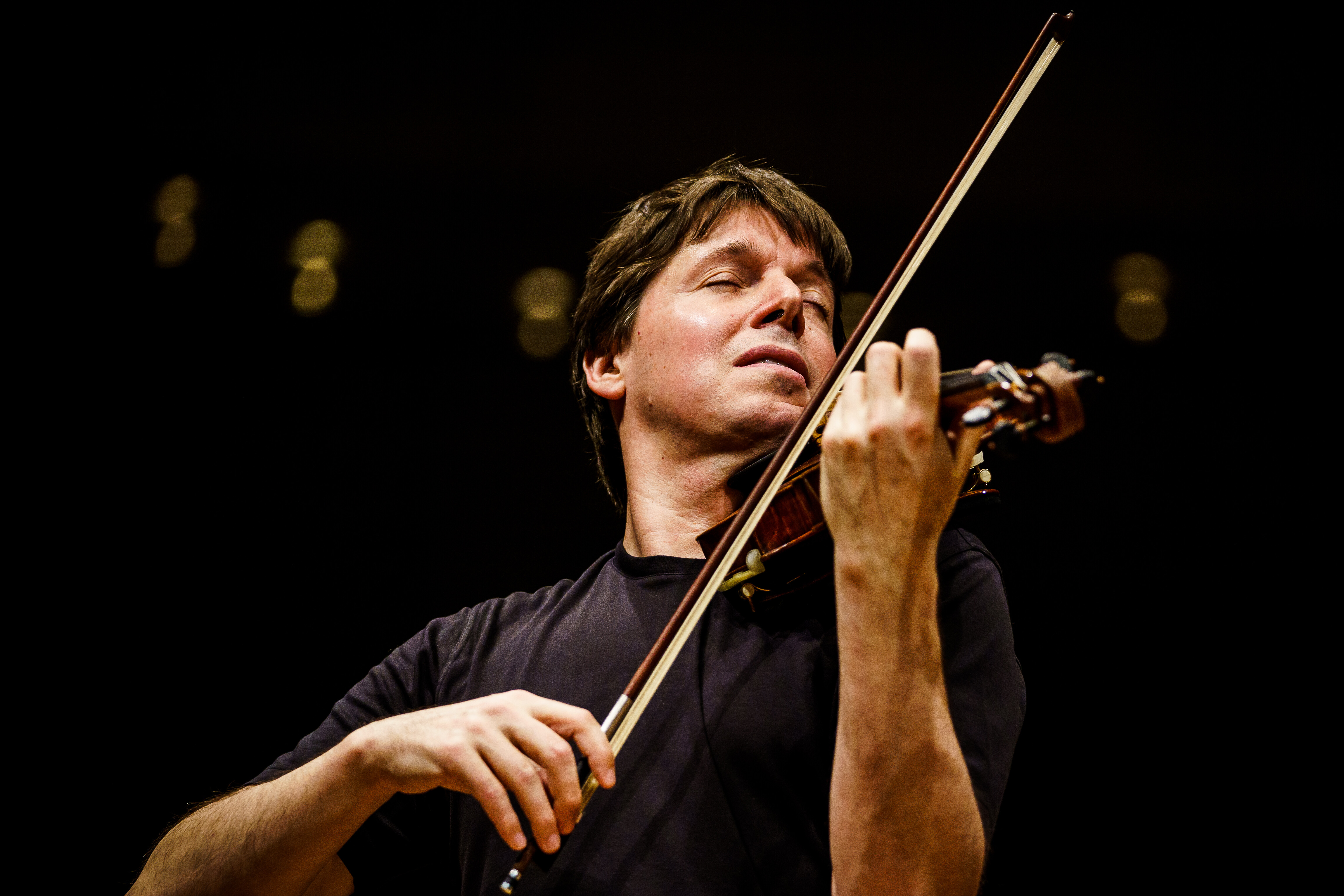
By Jason Dilg
Joshua Bell is a Grammy-Award winning violinist and conductor, currently serving as the music director of the Academy of St Martin in the Fields. He has recorded more than 40 albums and performed with virtually every major orchestra in the world, and regularly appears as a soloist, recitalist, chamber musician, and conductor. In 2025, he was awarded an honorary Commander of the Most Excellent Order of the British Empire by King Charles III for services to music. At 14, Bell debuted with Riccardo Muti and the Philadelphia Orchestra, and at 17 he made his Carnegie Hall debut with the St. Louis Symphony. He signed with his first label, London Decca, at 18, when he also received the Avery Fisher Career Grant. Since then, Bell has been nominated for six Grammy Awards, named “Instrumentalist of the Year” by Musical America, selected as a “Young Global Leader” by the World Economic Forum, and recognized with the Avery Fisher Prize.
Jason Dilg: This is the 25th anniversary of your acquisition of the 1713 “Gibson, Huberman” Stradivari.
Joshua Bell: It must be almost to the day; I first performed on it because I was playing at the Proms in London when I came across this one at the legendary Charles Beare's shop. It was 2001, exactly 25 years.
I wasn’t in there looking for a violin at all—I was there in the shop for something else. They said they had the “Huberman” Strad, of course I knew of the instrument, I'd even seen it and played a few notes on it some years before with Norbert Brainin, who owned it.
They left me alone for 10 minutes to play on it, and literally within 30 seconds, I started shaking. It was so clear. It was a love-at-first-sight type thing. I played on it that night at the Royal Albert Hall, which is unheard of for me. You need a month, at least, to get to know an instrument well enough to feel comfortable in front of several thousand people—and I was playing Bernstein's Serenade [after Plato’s “Symposium”] and [William Brohn’s arrangement of] West Side Story [Suite], which is extremely virtuosic and complicated. That’s the kind of thing where you would want to know your instrument very well, but I just had to play on it that night—and I never performed on my “Tom Taylor” Strad ever again.
I managed to convince them to let me take the violin home with me that day, and I had a deadline to come up with the money for it after September 11th, so it was like September 15th. I had to sell [the “Tom Taylor”] to get the money, and I literally got the notice that the person was going to buy my violin on the day of my deadline. September 11th actually happened just before, and the people that were buying my instrument lost something like $1 billion in the stock market, so I was absolutely sure they were going to say, “You know what, this is not a good time for us.” They were buying it for someone else to lend, in their generosity, but when you've just lost a billion dollars in stock market value, it's not a great time to be [making such a purchase]. I was sure it was going to fall through, but sure enough, they followed through, so it was very dramatic. Anyway, it's been 25 years since I've been playing on the “Huberman.”
Jason Dilg: Was there anything in particular that you remember from that first night where you were playing on it?
Joshua Bell: Well, there have been four Stradivarii in my life, basically. I've probably played on 150 of them over the years. I've played on a lot of them, I know a lot of them, but the first one belonged to my teacher, Josef Gingold, at Indiana University.
He had a 1683, which is 30 years earlier than my Stradivari. That was my indoctrination into the Stradivarii; he would let me play a few notes, and I remember at the time the overtones of the instrument, the sweetness. It was not a powerful instrument, necessarily, although it would project in a hall, but it wasn't one of those powerhouse instruments. The early Strads, I think, tended to have a sweeter sound, more based on an Amati model. I'm not one to speak on that, but it was these overtones and sweetness that I remember would just give you the goosebumps playing on it.
Then, when I was 19 years old, I got this violin—1726, I believe they're calling it. It was a funny-shaped violin, which was originally made as a viola d'amore and cut down. It's called the “Braga,” and it has a different, unusual sound, a little deeper, almost more viola-like sounding. It was a wonderful instrument, and it was what I could afford at the time, with some help from banks, obviously.
But I traded that up when I was 23 years old for the “Tom Taylor,” which is a late-period Strad, 1732. So I've spanned the periods of Strad's life, and they each have different qualities. The later period has a darker, more Guarneri-type sound, which is very appealing because it has a nice combination of Strad-like qualities. It doesn't have quite the sweetness of the earlier ones, but it has a richer, warmer, lower end, and I love the “Tom Taylor.” I still wish I could have kept it, because it has a very special quality. Many of my recordings, I did on that one.
But then finally this is the Golden Period one—the 1713 is considered from the Golden Period. What I found about the Golden Period violins, or mine in particular, was that it just had some of everything. It had the perfect balance. It was all about the balance of these sweet overtones. It had a surprisingly rich and powerful G string. I've always gravitated towards Strads, because I see the violin as being a soprano instrument, and Strads are known for their soprano qualities; that said, while some Strads I have played are incredibly powerful, I feel they're just a little too trebly for me. Sometimes, like when playing the Sibelius Violin Concerto, you want to go down into that G string and feel this rich, lower end.
But what really makes a Strad, and made this instrument, special is that it was not just loud, but there's something about a Strad that has this projection—and really, I think, the overtones are what do that. I've tried some modern instruments that sound incredibly loud under the ear, and you go out into the hall and it just doesn't carry the way the Strad does, which doesn't always sound as loud under the ear. But there's something about the spinning of the overtones that projects to the back of the hall. And when you know the instruments enough, you can already hear signs of it, even up close. Even though, technically, it doesn't sound as loud, you can feel what's going to project because you begin to recognize those overtones of what you know is going to project.
What makes the Strad special is not just the loudness; it's that the sound is somehow wrapped in gold. How would you say it? Either “gold” is the word—or “velvet,” maybe, is a better word. A great voice is the same way. Pavarotti's voice is incredibly projective, but it's wrapped in this kind of velvet, and that's what I look for in a violin, and I would say that's probably the one thing that is harder to find in modern instruments. And I have absolutely no idea how one would achieve that in the making of it. What is that? Is it the aging? Is it the wood? Is it the varnish, or when the wood was cut from that particular region of Cremona? I mean, obviously, that's the magic secret everyone's looking for. But it's that velvety coating of the sound. You're getting the projection, but yet this lush quality that frankly, the old Italian instruments have. That's the Holy Grail—finding that kind of sound.
Anyway, it's the goosebump factor. That's the kind of thing that the so-called “taste tests” we read about in The New York Times—where they test a Guarneri, or a Strad, against something else, and the Guarneri or Strad does not come out ahead. They are missing so much of what makes an instrument valuable to the player. It's partially that people aren't looking for the goosebump factor; they're looking for things like volume. And the way people test them, they'll play a scale from the G to the top of the E. That's not telling you what the instrument is providing for the player.
I own a Zygmuntowicz violin from Sam, and I love it. It's extremely open and easy to play. I love having his instrument. But I've talked to him about that, and he's done a lot of tests. There's something about when the bow hits the string, the response of an old Italian instrument, in particular, like a Strad. There's something about the lack of immediacy to the sound that is beneficial to coaxing a sound out of an instrument. Sometimes a modern instrument is actually too quick to respond when you're looking to play something with multiple colors of sound.
This has to do with the strings as well, and the setup—but there's a certain amount of play in the sound that you're looking for with the bow. When it doesn't respond so quickly, you have a certain amount of play. It is not easier at all to play a Strad. Certainly when I picked up the Zygmuntowicz, it was easier to play. You dig in; it responds. When I went back to the [“Huberman”] Strad, it took me a little while to get back into it, but then I realized, “Oh, if I do this with the bow, I can get a little different sound, and I can do this.” It's like a painter suddenly having a thousand colors on his palette to choose from instead of three.
That's what I find this violin provided for me. And that completely affects your interpretation of the sound. All of a sudden, you have all these options. I've been sort of trained to play like a Strad player. I use a lot of bow. I use variation of bow speeds in ways that you cannot do on a Guarneri. I've always been a Strad player, even thoughI'm intoxicated by a great del Gesù when I see it. And I've almost traded mine in on a couple of occasions for a Guarneri that I fell in love with. But I realize after a while, I'm not able to do the things I can do with the Strad because of the way I have to constantly keep the bow pressure, otherwise the sound doesn't project—you don't get that core.
Jason Dilg: I have had an experience playing instruments before, and this question of overtones, I think, is an interesting one, where the instrument was so well-tuned to its own generation of these overtones that happened from the activation of the strings … the latency that you described was present, and it was almost as though the instrument was building energy up that both gave back to me as a performer to say, “here's the energy, you figure out what to do with it”—while having this really dazzling brilliance across the entire spectrum of sound, from bass to treble. I wonder if you've ever felt like a surge of energy—I think of it, honestly, like a fine Italian sports car. I think about that moment of pressing the gas and then feeling the engine rise to the call for power. And that surge of energy I remember feeling from an instrument that I thought “Wow, this is really extraordinary.” I’m wondering if that is something similar to what you're talking about regarding your experience with your Strad.
Joshua Bell: I guess that makes sense. I mean, it's funny, because I have an old Italian sports car, and I also have an electric vehicle. Ironically, the electric vehicle accelerates twice as fast as this fancy Italian sports car. But it's immediate—you just step on it. But the old engines, they do give you a little bit more of that, that roar and the easiness. So, as far as the violin is concerned, I think you described it in a nice way.
The setup of a violin is extremely important. One of the biggest mistakes I've seen from violin dealers is that they will give me a violin, like a new Strad, saying that “this just came in and we're selling this Strad for $20 million,” and then: “you can give it a try.” It won't sound great, necessarily. And they'll say, “Well, we haven't really set it up properly.” Why are you showing me an instrument that's not at its peak? This has happened over and over again.
Thank God that Charles Beare had my violin, because knowing my violin now, there are times where I'm not in love with my violin because it is extremely finicky. I think all the Strads are, because they're so fine-tuned. It has to be running on all cylinders, as we continue our car analogy. And when they're all working, it's great. But every little thing affects the sound. So thank God that the day I got it 25 years ago, it was just in its best shape, because it's very possible that if it hadn't been set up properly, I would have said, “Oh, nice violin, but, it's not …”
I'll give you an example. I've gotten to the point offamiliarity with my violin; it's incredible. Just adjusting the chin rest on my violin, turning the tension on one side of the chin rest versus the other, or moving the chin rest half a millimeter backwards from over the violin, slightly giving the violin a little more reverberation, completely changes the response for me. At first, I told some violin makers about this. Even Sam Zygmuntowicz said he couldn’t believe it would have that much effect, and then I showed him the difference, and he was shocked at what that little amount can do.
Unfortunately, it opens up a can of worms because I'm always thinking I can control it. In a way, I wish I never knew this information, because five minutes before I walk on stage I'm still fiddling with my chin rest, moving it slightly to the left to clamp down on the bass side a little bit more. If I'm in a humid environment, I like to tighten up the instrument a little bit by just clamping the chin rest a slight bit more. If the violin's feeling tight from the dry weather, I'll loosen up the chin rest, and so let it reverberate more.
And another myth people are always talking about is finding shoulder rests that don't touch the back of the violin, so that it will be more “free-sounding.” I use a shoulder rest which clamps down on the instrument. Some people would say, “Oh, that's going to dampen the sound.” But actually, that's not always the case. In fact, sometimes, it's just counterintuitive. Sometimes you take off the tension from the back of the violin, and the sound is more diffuse and not as powerful. If you take a chin rest itself off the violin, the sound does not somehow become freer. I mean, it's freer, but it's not necessarily more … the sound feels a little diffuse and not … not … not …
Jason Dilg: Less focused, maybe?
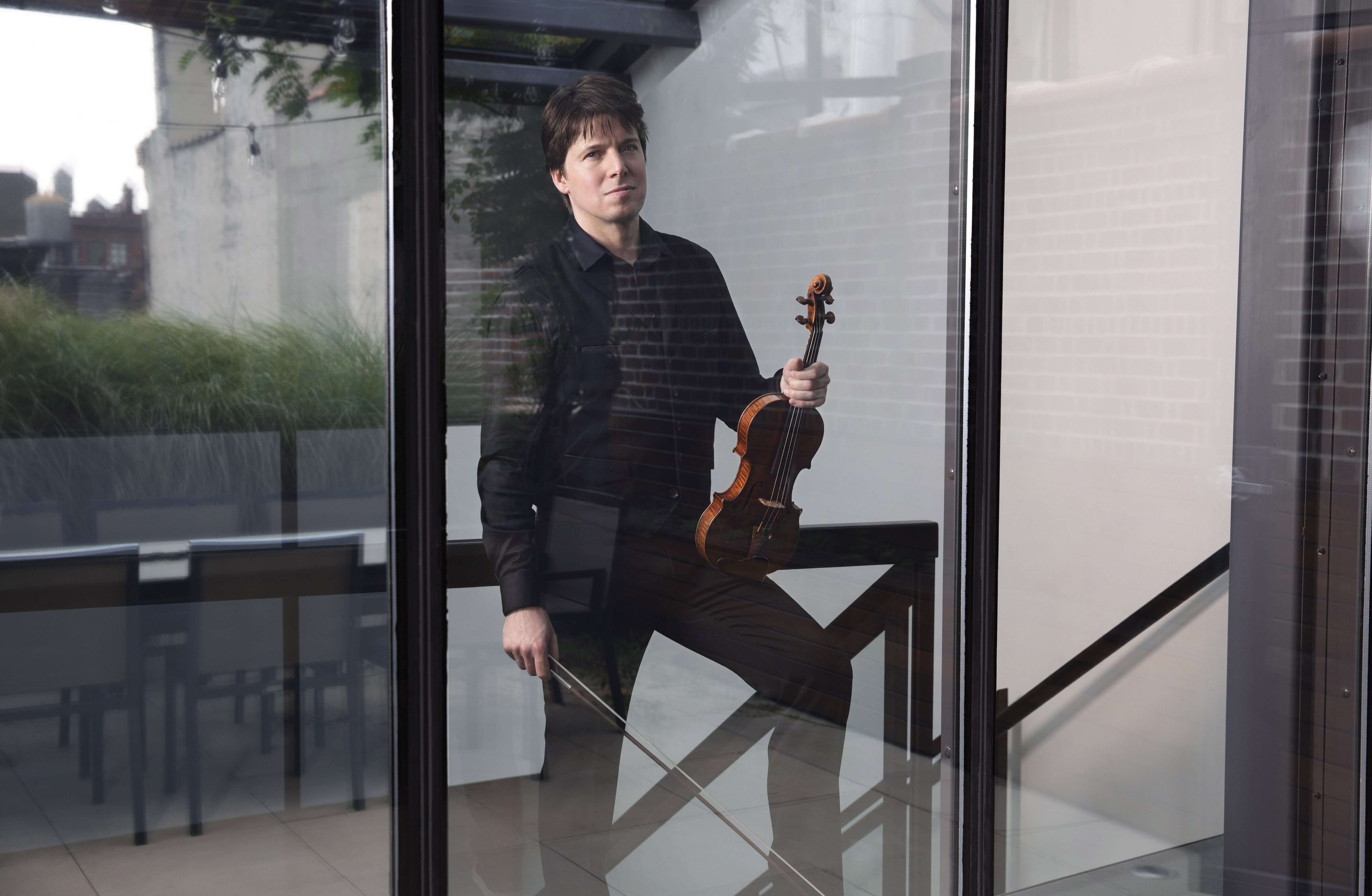
Joshua Bell: Less focused. Yeah. It's one of those interesting things. If you think of it, the bass bar itself on the inside of the instrument is basically a dampener of sound, and it's there for a reason. It's not there to make the violin resonate more, it's there to actually block some vibrations so that others can [be expressed]. I think the whole thing is extremely complex, obviously, as every violin maker knows, and it's something I don't understand that well, but after 25 years, I'm getting to know my own instrument and what it needs to sound better. I think there was a tendency in the old days with René Morel, who worked at Jacques Français: He was the master, everyone went to him, and he was brilliant, but there was a tendency to overcrank these instruments—to overtighten them, tighten the sound post too much. I don't know, something with the bridge as well—to make them really more powerful. And I've found with my instrument, allowing it to just vibrate, a little bit looser setup, allowing it to do its thing and to vibrate without trying to overcrank it has been beneficial for this instrument. You want the violin to give when you hit the strings. Because when it's tight … again, it's the immediacy of the sound. When you're playing Bach or something, you want that sinking into the strings, which you can do when the violin is loose, and that also has to do with the strings themselves.
I think every violinist should be experimenting with gut strings and understanding how gut strings work, because they'll be fascinated. I was fascinated by how the violin responds and the way you can dig into the string, and how you can get nuance out of the instrument with gut. One of my best friends is Steven Isserlis, the cellist that I've been playing with for 40 years. I saw a master class with him recently at Verbier, and he was talking to the players about the … what did he call it? “Whole bow disease.” People, including myself, are often taught early in life to use the whole bow. And if you play on steel strings, it's like slipping on ice. They respond so quickly. You can use the whole bow, but you're not getting any of that core underneath. When you use a gut string, you have to dig in more; you can't use the whole bow. You use what you need in that moment, and it allows you—if you're not constantly trying to use your whole bow on everything—it allows you so many more options and colors in music making. And he recommended to try to sometimes play on gut strings, and it'll teach you a great lesson about whole bow disease.
It’s a whole different way of approaching the instrument. Right now, I'm playing on strings by Larsen, and I'm actually working with them on creating a string, a personalized string for me. But what I like about their string—right now I'm playing on their gold set, which is very, very expensive—it's a little closer to the gut feeling. There's a little more give than these really steely, responsive, powerful strings that are out there … and that's what I'm looking for.
Jason Dilg: How does the bow play into all of this for you?
Joshua Bell: Oh, well, the bow is obviously, um … everything. I use a Tourte bow. For me, the Tourtes are in a league above anything else, particularly with the Strad, because the Strads tend to be very soprano sounding, and these high overtones, which, especially in front of a microphone, I fight in recording. These overtones are very bright. The high end in a concert hall, six rows back, you don't hear it, but with a microphone right up front, you sometimes hear too much of the high end. But the Tourte … I actually have three Tourtes. I've been alternating between two of them, depending on what repertoire I'm using. One’s stronger, one's a little more flexible, so more agile, and one of them is a little bit stronger. So if I'm playing the Sibelius Concerto or Brahms, I like the stronger one. If I'm playing chamber music or something that requires real agility, I play on the other one. But for me, the Tourtes have this chocolatey warmth that is a perfect balance for the Strad. There are other bows, like Peccatte … I've never found a Peccatte that works well with my violin, because the Peccattes that I've tried are like lasers. They have this incredibly laser-like sound, and, I'm guessing, would probably work very well with a darker instrument, like a Guarneri, where you need to actually rein in that dark richness of the violin, and you want a little more laser focus, and it brings out the higher end. So, matching your bow with your violin is very important.
I think you find ways to do whatever you need to do. In the end, they're tools, and the better the tools, the easier you're going to find your sound. When it comes to sound, sound starts not in the instrument, but it starts in your head. A good sound is not from the instrument, it's from the ear. So basically, if you give Heifetz any violin, he'll end up sounding like Heifetz. He chose his Guarneri because that was what achieved the sound, the Heifetz sound, easiest. But I firmly believe that any instrument you were to give him, he would have sounded like Heifetz, and it would have been fine, and in the end you find your sound in whatever instrument you're going to play. But some instruments help you get there more easily, and the same goes for the bows. And what kind of bow stroke you want to do, and all the things, whether it's ricochet or spiccato, you end up finding it no matter what bow you're using. But it's just some are like, “Aha! That's so much easier!”
It's still a tool and it's unique in probably any field in the world that our tool can be 300 years old and work better than anything else. I can't think of any other field where you are using tools that are still useful from 300 years ago.
Jason Dilg: Are there works that are coming up that you're excited about presenting over the next year or two?
Joshua Bell: Well, there are a couple. First of all, I have an album coming out of Paganini: a piece that I played when I was 13 years old and then revisited as an adult, the Paganini Violin Concerto No. 1. I saw it through a very different light as an adult and really appreciate it as a masterpiece, which it really is. This concerto is an incredibly operatic, and dramatic, and amazing piece that's often relegated to prodigies and as a technical feat—but it’s really great music, and I wrote my own cadenza for it. There was this one by Sauret, which is a six-minute display of technique that always left me wanting musically. There just weren't a lot of other options, and I wrote my own, which is probably a lot easier, and much shorter, but I'm really proud of it, because I write all my own cadenzas for all the concertos, and I'm happy to include it in this new recording. So I'm excited about that coming out.
And I just received a MIDI file, which I have not even opened yet, from Kevin Puts, who's just an incredible composer who wrote “Earth” for me, of which I did a little bit at the TED Talk. A couple years ago, I commissioned these elements from five different composers: “Earth,” “Wind,” “Fire,” “Water,” and “Space.” And he did “Earth,” and I loved it so much that I commissioned him to write a full violin concerto, which I'm going to start workshopping next summer.
Most composers are usually behind schedule. He got going and basically finished the first draft, and now the fun part is going to be working with him. He's very open to the collaboration part, which is what I love to do. I did that with John Corigliano and The Red Violin. I enjoyed giving my two cents here and there with the violin part. So, Kevin sent me the MIDI file almost a month ago, but I was so busy that I actually didn't want to listen to it, because I'd start going down that rabbit hole. So I told him, “I'm going to wait till August.” So this week, I'm gonna listen to his synthesized version with the orchestration and the violin part, and I'm very excited about a new violin concerto from Kevin Puts.
Jason Dilg: Is there anything in particular that you look for when you're looking for new pieces? I'm thinking a little bit about the Thomas de Hartmann Violin Concerto for instance.
Joshua Bell: That was written in World War II and it was newly discovered, which is in some ways even more exciting than a new piece because it's like this has been around for so long and no one's played it. There are gems out there from master composers that just are not played often that you can find on occasion … There are two other concertos that people don't play. I recently played the Scottish Fantasy of Bruch, which is highly underrated, although it is played by a lot of violinists, but not compared to his G-minor concerto. And so a piece like the de Hartmann … when I listen to a piece, or look at a piece, all I really look for is, “is this a story that I feel I can tell?” So when it comes to playing a piece—this goes for Beethoven, or Fauré—I have to feel that this is a piece that I want to tell the story, in my own way. It has to be calling to you that you have a unique perspective and a way that you just are dying to tell this story. And it involves a little bit of the goosebumps again. What gives you goosebumps? What is it that moves you? There was a live recording of the de Hartmann that’s the only recording that was out there. I can't remember the name of the violinist, but it was very good—from, I think, the 1950s—and it just immediately gave me goosebumps. The harmonies and the soulfulness of the piece immediately went straight to my core. When it comes to any music, whether it's new or old, this is my criterion. It has to go to my soul. I know this sounds really highfalutin, or almost self-aggrandizing, maybe, by saying that I …
Jason Dilg: No, I don't think so. I hear you saying that it has to speak to you on a personal level.
Joshua Bell: It has to—on a deep level—because the music that we're trained to play, all this Bach, Beethoven, Brahms, et cetera, et cetera, moves you on such a deep level that we're spoiled. That's what music is. Otherwise, why are we getting up on stage and playing for 2,000 people, unless it's taking you to some very deep level? And probably the reason I've been hesitant with new music—and I do regularly play new music, but I'm not just jumping out there playing a million things—is because I want the same thing from new music. It's not enough to say, “Oh, that's interesting,” “That's provocative,” or “It makes a political statement.” For me, that's not what music is about, the music that survived 300 years. A lot of music was written that didn't survive because it didn't do what these great pieces do. But with new music, we've got all this stuff that hasn't stood that test of time, and we have to do a lot more work to sift through and find those things, and they do exist, but you really have to look for it.
I feel that composers should strive for the same ideal. And many of them do. But the same goes for art. I guess you might say I'm very conservative in that sense. Barber's Violin Concerto was beautiful right from the opening. It's like the most gorgeous opening, and it was frowned upon by the composing community at the time.
When we were doing The Red Violin, John Corigliano, I remember, did a seminar in Canada with about 50 other composers, and he talked about how he wanted the audience to like his piece. He was basically, practically booed out of the room. But, who are you writing for, then? You're not writing for some sort of esoteric purpose. I think music, for a while, became so disconnected from the player and from the audience. I think during a lot of the 12-tone era—which was an interesting experiment—the music started being separated from the audience. Even Mozart wrote letters back to his father, worried that the audience didn't enjoy his piece the way he had hoped. Composers wanted to connect with the audience, and with the player, it's the same. Luckily, I think we have a ton of great new young composers that are writing today and understand this, who are seeking something beautiful without being trite. That's the hard part, is to write something that's not trite and done before.
Corigliano, Kevin Puts, Edgar Meyer … these are composers that are writing things that are beautiful to the ear, but innovative and unique and unlike anything else. That's what I'm looking for.
Jason Dilg: For the older pieces that you're dusting off, so to speak, is that typically based on exploring old recordings? I am trying to imagine how you would come across these old pieces.
Joshua Bell: Just yesterday someone asked me: “Have you heard this Saint-Saëns piece … for a small orchestra that has a big violin solo? It'd be right up your alley for the Academy,” because I conduct and direct the Academy of St Martin in the Fields. We're looking for pieces, and one that includes a violin solo is perfect. I can't remember the name of it, but I'd never heard of it, and it's rarely played. So, these gems are out there. Heifetz recorded a bunch of concertos that were written for him that are rarely played anymore. Some of them are just masterpieces that need to be played. The de Hartmann was a piece that needed to be played. They're out there. I love YouTube as a resource, because you can find almost anything from either historic performances or a young person that discovered something but doesn't have an audience yet—or may never have an audience—but they discovered it and recorded it in their recital. You find something new, and that inspires me to go find the music. We're always looking for these gems, because programming is a tricky, tricky thing. You want to play the warhorses, the things that people know—like the Kreutzer Sonata—but you also want to introduce them to new music, and old music that they won't know.
So a good balance of those things, something new, something that's never played because it's new or rare, and maybe something old like Grieg’s First Sonata, or a late Fauré that's not [so well known], and then at least enough of the old warhorses that it keeps people coming to see that. Finding and programming the right balance of things, educating while providing them with things that they feel comfortable and know, is an important part of what we do.