
Sam Zygmuntowicz: An Interview by Fan Tao
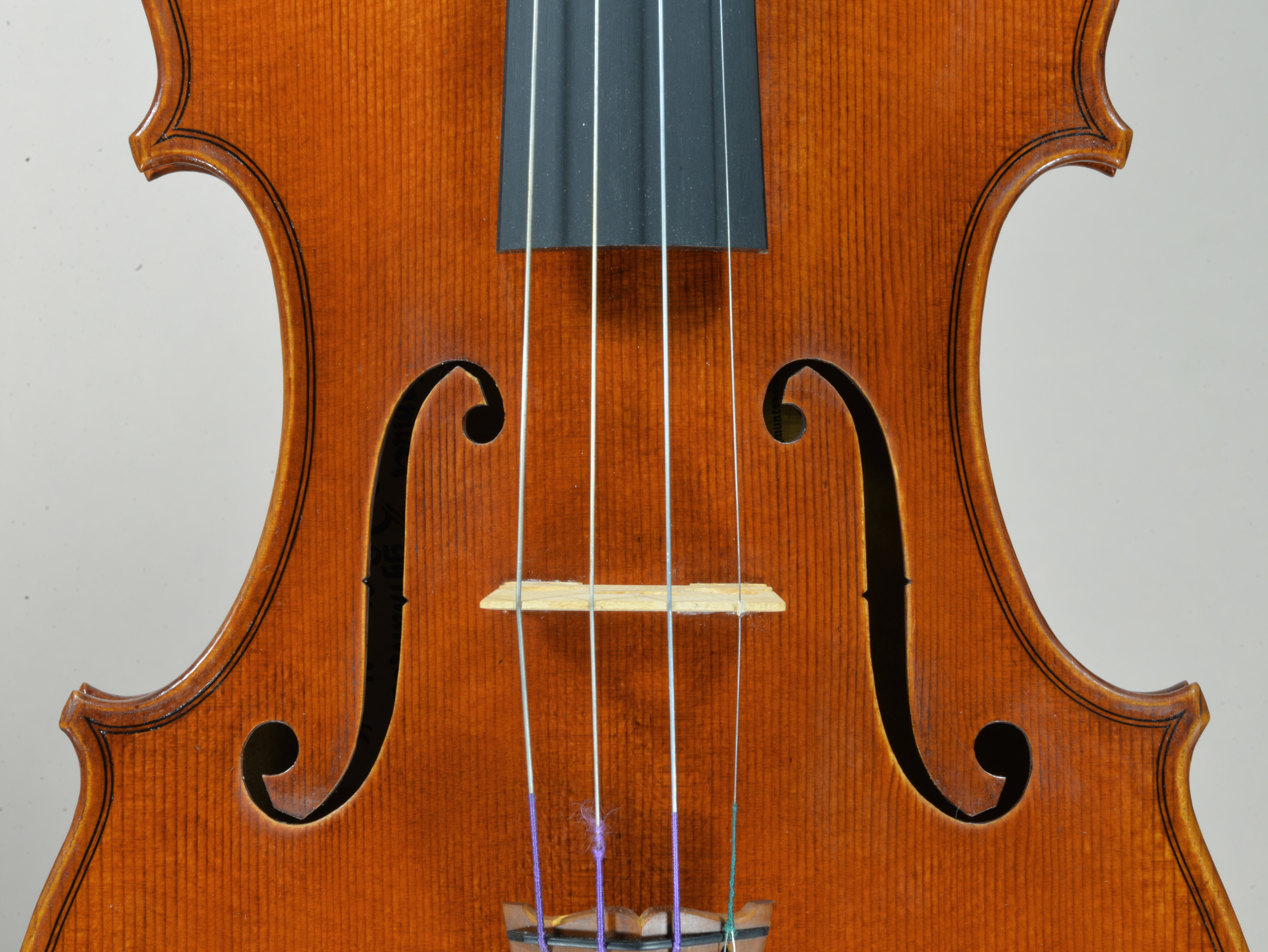
The following is a complete transcript of an interview by Fan Tao with master luthier Sam Zygmuntowicz. They discuss blending traditional craftsmanship with scientific inquiry, and how Sam explored instrument making and the needs of modern musicians throughout his career. Conducted in July 2026, a portion of this conversation appears in The Scroll, Vol 11, No. 3 Summer 2026.
Sam Zygmuntowicz is one of our most preeminent makers working today. He has completed almost 320 violins, violas and cellos to date with most of them being played by the top professional string players in the world. He recently took time from his busy schedule to share his thoughts on his career, major influences and violin making. From our first meeting over 25 years ago, I have always been struck by his never-ceasing curiosity about how the violin works and his never-ending quest to improve his instruments. I saw where these seeds were planted from his childhood and formative years, and how his approach to his craft has resulted in his success.
Fan: This sounds like a super busy week for you.
Sam: I had lined up clients for adjustments and then my brother flew in from the West Coast, my other brother came in from Long Island and so I was hosting family all week. My music room is covered with sheets and fold-out beds.
And then this Gala [recent Chamber Music Society of Lincoln Center Gala honoring Sam] was quite a thing. There were 900 people in that hall for the ceremony.
Fan: Wow! 900! Amazing!
Sam: And the gala dinner was, like 380 people, and I had to give a talk and I had to buy shoes.
Fan: I think it's great they are honoring someone who has contributed something rather than just someone who can give lots of money.
Sam: Well, they were talking about that, and I think there was a lot of excitement. It was a novelty for one thing. But apparently, it was a very successful gala. David Finckel is the force behind all of this. But I think I have a certain utility for them.
Fan: I get the sense David Finckel is really good at fundraising and selling projects and ideas, and as you put it, this was something unique, and he had no problem selling you.
Sam: That's exactly right. I think both David and Wu Han just signed on for another 6 years as Co-Artistic Directors of the Chamber Music Society of Lincoln Center.
I don't know what the numbers are, but they've hugely increased the endowment, and they've multiplied the programs they do. They have CMS branches in Palm Beach, and in China, and other places. And then they have the Bowers program, they call it. It used to be CMS2, which is younger people they're bringing in. They're always generating so much.
It was interesting to see it from his perspective. I appreciate the attention, of course, but I'm a little uncomfortable with it and I feel like it's a little oversold in a way, you know what I mean?
Fan: They have to do that to raise the funds.
Sam: In the case of the gala, I think that they were excited by this as a model for things to do in the future. I was instrumental in letting them change the paradigm a little bit. And I think that's also been the case with new instruments, for example, the Isaac Stern auction has been useful to shift the paradigm for young musicians. So, it's not really a question of whether it's true or deserved or anything, it does exist, and I'm trying to understand it from their perspective.
Fan: For the violin world, this is one additional little step in the acceptance and recognition of new instruments.
Sam: Yes, exactly. It was amazing. There was a concert, and there were four violins, and a cello, and a viola of mine for the concert, and they sounded good. Do they sound better than every other violin ever made? I don't claim that.
Fan: I'm sure they sounded at least as good.
Sam: Well, you know, it's interesting. I can just send you to David Finckel’s interview in The Strad if you want more hyperbole, but what he says, which is true, is that it's not just one instrument of mine. It's one instrument after another. And there're no duds. It's over time. There's a trajectory, and it's the instruments themselves coupled to the public perception of them, and that has really shifted. That's how David sees it.
David and Wu Han, they are totally about their project and their mission, and their young musicians. Whatever serves that, they're good for it. I fit into that vision.
Fan: Since we're on the subject, how did you first meet David?
Sam: I was making instruments all along when I was at Jacques Francais and Rene Morel. I would show my work to Rene quite a lot and get as much coaching as I could. I had started to make copies during that time because it seemed that was the opportunity to study instruments. And that was clearly what was most in demand. I made a copy of the Cessole Strad. I started it in my last year and I finished it, I think, shortly after I left Morel's. And through some circumstance, that violin got shown to Eugene Drucker [member of the Emerson String Quartet]. And Eugene bought that violin. That was my first contact with that slice of the New York chamber music professional world. Eugene has had his Strad all that time. At one point, he was going to sell my violin to buy a Pajeot or something like that. David said ”you can't sell that violin” so David bought the violin from him. As David tells it, when he saw that violin, no one knew what it was at first, and they thought it was a Strad and David's eyes lit up, that new instruments can do this. So he contacted me, and said I want a cello like that violin. That's how this started. That would have been 1987. That's when I started the commission for David which got finished in 1993. And that violin which David wound up buying has been lent, I don't even know how many times, to at least 20 different young upcoming artists who needed instruments. Probably half of whom commissioned instruments subsequently from me.
So that one violin is itself a saga. They had it on stage at the gala. And that's how that started.
David and I talked about what the new cello should be, and we talked about our favorite instruments, and we listened to recordings together. And he had been sort of a protege of Rostropovich. So the Duport Strad was an instrument that David knew well and he thought it was great. He went out to Long Island, where Rostropovich was conducting, I think Anne Sophie Mutter was playing. He showed my violin to Rostropovich
Rostropovich would not ordinarily have done it but he was very fond of David, so he said, okay, you can visit, and you can document the cello. So David and Wu Han and I went down to Washington in the spring of 1988, maybe? And, we spent the day with Rostropovich, and the Duport Strad. And then that new cello got made. It wasn't done until 1993.
That's the beginning of it, but from that, Phil [Setzer] commissioned a violin sometime later. Larry [Dutton] eventually did, and Gene [Drucker] commissioned a second one.
And then Danny Phillips independently, at that time, had also commissioned. He was a neighbor of mine. And he used to try my violins, because he and Todd [Phillips] shared a brownstone not far from where my shop was. I remember Danny said at a certain point, “I think they're good enough now that I want one”. That took a little while to happen. So Danny was a supporter, and then Todd got one as well. Cathy Cho, who's Todd's wife, also bought one.
Sort of independent of this, around that same time, Isaac Stern ordered his Ysaÿe copy. And around that same time, Walter Trampler asked for a copy adaptation of his Amati.

From left, Sam delivering his 1991 bench copy of the Guarneri del Gesù 1740 “Ysaÿe," which Isaac Stern holds. Photo by Stuart Pollens.
Fan: Stern was one of your most famous clients. How did that relationship start?
Sam: Did you know Alex Cores? He was sort of a behind-the-scenes figure. He played violin for Toscanini but became a salesman for Jacques Francais.
Well, actually, it all goes back to that 1986 Cessole copy, that same violin that Gene bought. Eric Wen, who was editor of the Strad at that time saw that violin at the same time, and then commissioned me to make a violin copy of the 'Kreisler' [Guarneri]. And Strad Magazine documented the making of that violin over a period of a year or so. And then Stern saw one of my Kreisler copies. Depending on the story either Stern saw it and got interested, or Rene Morel recommended me, so I don't really know. But it was sort of under Rene's benevolent guidance.
Mr. Stern never came to my shop, personally. I would meet him at Morel's. And then later, when I wanted to study the violin, I would go to his apartment at the Beresford. But that was with Rene's blessing. And I made the first one that was done in 1991. I think he really liked it. I actually wound up taking it apart once after he had it for a little while. I asked him how do you like it? And he says, oh, it's good. You know, it's not as deep as the Guarneri, and I said give it to me and I'll do something.
So I took it apart, and it was thinned strategically, and it was better. He ordered a second one of the 'Panette' [Guarneri]. And so that's how that started. Mr. Stern was a connoisseur of instruments and a patron of many people, and he used those violins and lent them to students.
I think for him, he had many young people that he was mentoring and they all have the same issue that David and Wuhan have. They have young, talented people and they don't have good instruments. So as part of their mentorship Stern and David and Wu Han, similarly, you gotta get these people good equipment so that they can come through. The impetus came as much from them as it does from the younger musicians, because younger musicians don't have the perspective. But they're entering this bigger arena, and the people who are mentoring them need them to step up in scale what they can do. So, I think I've been useful in helping them up the intensity of their young protégés.
There were people who came through Mr. Stern, certainly a lot of people came through David and Wu Han, and then through Danny. So that's how that started.

Sam's 1991 bench copy of the 1740 del Gesu "Ysaÿe, Stern"" violin.
Fan: We jumped into the middle and end of your career. Let's go back to the beginning.
Sam: I was involved in sculpture from the youngest age. I was a very quiet kid, I read a lot. I was really indifferent to school. I left them alone, they left me alone, that was pretty much my school career. This was in Philadelphia. My parents are immigrants.
My public schooling and all that, I sort of appreciate it in a way, because I feel like teachers saw that I was just not like the others. I had my own thing, and I wasn't bothering anybody, and they left me alone. And then I developed most of the things that are important to me outside of schooling.
I did sculpture from a very young age. I won some small school prizes for my sculpture. And I also had a microscope, I just loved how things work, and I had my brother's biology books with the overleafs of the nervous system and the muscular system, and the digestive system. I was dissecting things, and everyone assumed I would just continue on the art path.
And then I read a book about a violin maker when I was around 13. I also got the idea that I wanted to try to make instruments. I first finished a balalaika from a kit, with a Swiss army knife. Then I actually started trying to make woodwind instruments, and I was trying to make flutes out of Japanese knotweed, it’s a reed like bamboo. In the beginning it was all self-taught.
It's not totally clear to me why but I sort of turned from sculpture. I think I just got the idea that the art world was too subjective and it wasn't about Renaissance art anymore, or Rodin, who was my hero.
But I basically started out self-taught. I wanted to make these flutes, and I went to the library looking for books on instrument making, which there really weren't many at that point. But it's interesting for me, because the books I found then, I've repurchased them over the years. One of them was by Curt Sachs, you know, it's this big organology tome, The History of Musical Instruments. And I sort of tried to reverse engineer how to make a flute based on these little sketches of flutes made out of human thigh bones and stuff like that.
The other book I found was Horns, Strings and Harmony, which was by Arthur Benade, which is a layman's simplified guide to musical acoustics. And it had some projects in the back, like how to make a flute and a clarinet out of Plexiglas tubes, which I actually bought the Plexiglas and did some of the projects.
And I found, Steel String Guitar Construction and Classical Guitar Construction by Irving Sloan. And maybe Jean Ritchie’s Dulcimer book. These were books that were around at that time.
And eventually, I found Heron-Allen's book.

Sam working with modeling clay at age 11.
Fan: Oh, yes, the famous Heron-Allen!
Sam: It was a charming book.
The first book that I read about a violin maker was when I was 13, I got in school. I didn't even remember the name of it but the story made an impression. Anyway, this is a digression, but John Dilworth's assistant was a Hungarian guy for a while. And so he knew the book, and he found it on a London book table and sent it to me. The book is based on a historical thing, about the Konya family, about Stefano Konya, who came from Hungary to Cremona.. So I was able to re-read that book, and then I tracked down the Horn, Strings and Harmony, and I tracked down the Sachs. And I got a new copy of Violin Making As It Is and Was.
I hated school. I didn't really hate it, I just didn't care about it. It's interesting to me that most of these things in my life came through books I read on my own. And a lot of things in the books are little dramas that I have re-lived in my own career.
So there's a book called The Violin Maker, which was that one I'm telling you about, it has this guy, he's a refugee from Hungary, and he walks across Europe in post-war Europe, and hitchhikes on trains and things like that. He had an invitation to be a teacher at the school in Cremona, because a lot of Italian violin makers have been killed. I think this is sort of true, that part of it, the nugget of it. The rest is very romanticized. He gets to Cremona, and he's all ragged because he's just been tramping to get there, and he has a little tool roll of his few tools, and he's got this wrinkled letter of invitation, and they give him workbench space, and he makes a new violin, and then there is a festival where they play, I don't know if it's a Guarneri or a Strad played as part of this festival, and then they play his new violin, and the old violin has a golden tone, and the new one's silvery, but whatever, it launches his new career.
I remember later when I made my Kreisler copy in 1987, we went down to the Library of Congress with the new violin, and Daniel Heifetz played it back-to-back with the original. This is kind of like that story. That new violin ended up on the cover of The STRAD.
Fan: So back to your instrument making. What pushed you towards violins versus other instruments? Did you play the violin?
Sam: I didn't play the violin at that time. I had started to play banjo, and I played recorder and that's why I wanted to make flutes or recorders. And in fact when I first read about violins, I thought I was not drawn to it.
One of the first stringed instruments I made was an Appalachian dulcimer. I made two of them. I think to this day, it's the most creative work I've ever done. I designed every aspect of it including the pegs, and there's a different design for the scroll, and I designed the bracing, and the sound hole, and came up with a novel way of fitting fine tuners into the end block. I just made it all up, and my impression was that violin making was very constrained, and very tradition-bound, which is, of course, true.
What makes violins constrained is that there's so much more known about them. And there's so much more to learn about them. A dulcimer is basically like something that people in the backwoods made out of whatever… they're every which way. There's no one way that they even need to sound, or that people think they should sound. Where violins, there's a very specific target and a very specific standard.
And the other thing is in my first attempt to study more, I actually don't remember if I sent out these letters, but I composed letters I think when I was 14. To a couple of woodwind makers to try to get apprenticeships. And, of course, you can't hire a 14-year-old kid, you know? That’s the other thing in answer to your question, why violins, is that you can study violin making in a way that you can’t study almost any other instrument making. You can take a course for like three months in guitar making or something like that. If you wanted to be a woodwind maker, most of those places are more industrial anyway.

Sam working with a dulcimer in 1973.
So violin making is where professional musicians are paying real money to get really well-made violins and there's a lot of knowledge to be had. It's a viable ecosystem
And then around that time, maybe a little later, I started visiting violin shops in Philadelphia. There was Primavera, there was Moennig and Keller. The people were perfectly nice, but nobody could really do anything with me.
And then I think through a family acquaintance, I got a job in a music store with a violin shop called Zapf’s Music Store, which was a big general music store, but it had been founded by German immigrant violinmakers who came here in 1923. It had organs and guitars and sheet music and all the stuff, there's drum sets. But it had the original old shop from when they started, because they kept expanding and expanding. But the original old shop was this little dusty place with stacks of ruined bows and broken violins. It was down, sort of in the back. I was the assistant of one of the founders, Sofian Zapf, who was a very kind man. He was actually a specialist in zithers as well.
It was interesting, because it was not a high-level shop like Moennig. Primavera was a little more complicated, but still a more Main Street shop. At Zapf’s, they did violin work, but it was, like Manny's or Sam Ash or something like that. But Zapf’s had an old Czechoslovakian guy, Roderick Schuster, who was a bass maker, and a zither maker, and just a real thick-wristed, tough, old guy who barely spoke English.
They were not the snooty current violin makers. They were the remnants of the old working violin makers from Bubenreuth and Markneukirchen. And so it was very workaday, and I learned how to sharpen tools and I learned basic tool working and just got that atmosphere, and I did repair work there. I was there for 3 years. It was a good place to land but there wasn't much room for advancement. The kind of repair I wanted to do was pushing the limits of what anyone there was doing. They weren't really taking in restoration work, so I was kind of starting to teach myself and there was a point, I guess when I was around 18, I had to decide, okay, am I going to really study violin making very seriously.
I wondered should I still go to art school? My mom was a kind of a romantic intellectual. Even though she was an immigrant, and didn't really have any education, she would have gone that way if her life hadn't been torn apart, and she was sort of a romantic and she saw me as an artist. Violin making was not anything that she knew anything about. Anyway, I started to put together a portfolio for art schools I was thinking of applying to. My choices were art school, or I was sort of interested in ethnomusicology, because I was playing fiddle and banjo and things like that, and playing with a lot of folk bands and started to play gigs, and interested in different types of world music. Or should I go to violin-making school?
So I took a train trip. I got an Amtrak pass and took a month trip, and I think I did like 12,000 miles through the country. I visited Wesleyan, which had an undergraduate Ethnomusicology program. I visited Bloomington, Indiana, which had an ethnomusicology undergraduate program. I visited the Chicago Violin Making School and the Salt Lake City Violin Making School.
I remember sitting in on some classes at Wesleyan. Anytime I sat in a classroom, I just felt like, this is just not for me. I'm sure nowadays I would be diagnosed with all kinds of learning issues and things like that. I don't like being in a classroom where the pace is set in a group externally, and you have to just sit there and keep up. That's my least favorite way to learn.
It’s very passive, and I'd always get interested in something and look down, and then I'd look up, and something entirely different would be going on. At Zapf’s music store, Sofian Zapf was a very nice man, a very kind man, and I really was very attentive to these kinds of one-on-one teachers. And I really was seeking out, and eventually found, real masters to really dedicate myself to.
Anyway, at the end of the train trip, I applied to Salt Lake City. And got in and then decided to go. And it went on from there. I was in Salt Lake City for three years. It’s a variable-length program. It was designed as a four-year program. But I already had a lot of experience at the bench, and I just sort of zipped through it rather quickly.
It was another kind of school, to be honest. Peter Prier was a fine craftsperson, but someone who's running a school is running an organization, and he wants people to fit into the organization. He's not looking for stars to pick, to single out. I think that I was more of an annoyance to him.
Fan: It was school again. You had to sit through more of this, classes and stuff.
Sam’s: That's right. I think that at the core, or at its best, the transmission of knowledge is direct from a master who has authority, not because he’s got a title, but because they have mastery of what they do. And then because of their mastery, it induces the student to dedicate themselves and to submit themselves to that superior mastery.
I used to go back and forth by train and during my first trip to Salt Lake to take the entrance test, I stopped in Chicago, and I met Carl Becker. And I showed him a violin that I had restored, kind of on a self-taught basis, and he was like, “it could be worse”, you know? It was an ambitious restoration, but I didn't really know what I was doing. And it came out okay, it was functional.
And then, I visited him again around Christmas time or something like that, and he saw some of the work I had been doing in Salt Lake, like I'd gotten some instruments purfled. I think he saw improvement and promise. And so that first summer, I'm a little fuzzy on how it happened, I was offered an internship.
I was with him for what was supposed to be 3 months, and then it stretched out to 5 months. Becker was a true master, and also luckily, just a very kindly person.
I remember him saying [when I expressed an opinion about the work], because it was his father who started that business, “if my father was here, he would just give you a look”, because I have a sort of inquiring manner, and it could be a challenging way of asking questions sometimes, and if you're the wrong person, you could take it as an affront. But for Carl, he had the answer. It was not threatening to him. Now, if I asked him, he would tell you why, and what the alternatives were, and what that meant, and why you might do it differently, and it was very inspiring.
I actually had the opportunity to stay there at Carl's and not go back to school. Which I'm not sure exactly why I didn't take. I had reasons, the Beckers were a family dynasty, and they were very into their family dynasty. I didn't feel like I was going to ever be a Becker or something like that. And I thought that finishing school would be more of an independent basis to go forward.
Much of my making is still based on those 5 months with Becker because I was working for him 6 days a week and then I would go to the shop every night, and on Sunday, working as intensely as I ever could. I did nothing else. Because we were also out in Lake Pickerel, where they had their summer place. There’s nothing to do so I would just live in their cabin, I'd work for him, I'd go home. Wolf something down and then go back and work until they chased me out at night.
So I made a violin there, or a violin and a half. That's still the basis of a lot of my making, Carl's methods, because they were very efficient in their peak. It was sort of before my time, but when it was Becker and his father, they made a lot of instruments. And very beautifully but quite efficiently.
Fan: Did you graduate from Salt Lake School?
Sam: I did, but in 3 years.
Fan: What did you get out of that experience?
Sam: The main thing is you're in an environment where everyone's thinking about violins, the books are there, you get your shop set up, there are people to help you find tools, and it's a community of people who are all working on that.
I did pay a lot of attention to Peter Prier and I'm sure I did learn a lot from Peter as well. Peter was a very intuitive, very straight-ahead worker.
Fan: It sounds like your main experience out of the school is that you were surrounded by serious people who were serious about making violins and that was your full, sole focus. It was your first exposure to that larger community of violin makers.
Sam: Yes, and I'm still friends with many of the people who are in my class. John Waddell was my roommate, Ben Ruth was an old friend, and I knew him playing Irish music in Philadelphia before this, and Tom Croen was a very close, and they were some of my best friends there. Lisbeth Nelson was part of that class, and Kerry Keane. There was an intensity. Everyone was setting up their own shops. We were in school, and then we were working at home, and starting to cook varnishes.
Fan: Back to Carl Becker because I want to dig a little deeper into your making when you said your making was based on what you learned from the Beckers. Was it based mainly on their techniques and or was it also their attitude? My impression is that they were very meticulous and exacting makers and that must have had a profound influence on you.
Sam: Yes, the Beckers had several things going on. One is that they were master restorers. There wasn't so much of it going on during the time I was there, but they restored the “La Poucelle” or maybe the “Lady Blunt”, you know? The Beckers were famous for time-consuming, meticulous, painstaking restorations that no one else could afford to do because it just took forever.
But also there were very complete systems. They had little gadgets. You’d ask them, how do you do this? And he'd pull something out of the drawer and he'd have some little templates. And he had a chart, a way of graphing the graduations on the back, and he would draw where the center was, he had a way of doing that, and then he used compasses. He had a whole system for drawing it out. And he took careful notes on all his violin graduations. I hadn't been around that many other makers, but people weren't really doing that in Salt Lake yet, and I think it's quite universal now.
Fan: I certainly see that in your record keeping, note-taking, and your gadgets and accessories in your making.
Sam: Right and they had a lot of that, and they'd been doing it for a long time. Everything was very thought through. I think they were sort of past their peak production as makers, if I may dare say, during my time there. The father [Carl G. Becker] had just passed away right before I worked with them, and Carl had one or two new violins on his bench, but I wasn't there that long, and I never saw anything getting done, getting finished and out the door. They were involved in dealing their own violins, other violins. My work with them, my daytime work was some restoration and also some acoustic refinement of commercial instruments. So I did a bunch of regrads and a bunch of bass bars, which was great practice.
I remember thinking, and I still think, that the Beckers, their timing was a little off because we have this boom time for new making. And they had the reputation, and the wood, and the materials, and the routine. They should have been at the peak of that. But they weren't really that active as makers by the time that happened. In this time, they mostly did restoration.
They had worked out all their own methods, like how they would make the ribs. They'd make the plates according to templates [during the summer]. It was more like a hybrid system, almost like the French system, and they used it. For the ribs, it probably was inside molds, but they were half molds. And then they would assemble them back in the city, because if the plates shrunk. They would make the plates independently, make the rib halves independently, and then when it was time to put them together, they would cut and make the rib joints, and glue them down and put the blocks in so they could make it fit.
And then they would do the varnishing during the winter, which I never got to witness. That was their family secret, of course. They didn't really want to talk about it, which I respected. He did share his ideas about varnishes. He was like, I'll talk about anything, just don't ask about varnish recipes, because that's a family thing, and I was very respectful.
But it was a very complete system of every aspect, thought out and documented and efficient, with templates, measurements and record keeping. Plus, the foundation of their style was observation of great Strads that they'd seen. And they idealized it. What we consider the ‘competition style’, I don't know what that is even anymore, but what it was when I was coming up was like a pristine, “Messiah” like Strad. That was their work, that's the Becker style.
It was based on very careful observation, and I could go on at great length. And the Beckers, the other thing about them, which was a little like Rene Morel, is that Carl was a master adjuster. And they were very involved in the sound of their instrument and very involved with musicians.
So they were there in Chicago and they had a very loyal clientele. I participated in adjustments with Carl, because I played enough that I could play for him, and then he did things like with little taps of the bridge back and forth, micro-adjustments that no one else did. They were very powerful. He had a lot of thoughts about bridges, and it was all very thought through, and he had a sound ideal, and a vocabulary of sound that matched and went with his sound ideal, and he used to talk about it. A word that he used a lot was a broad sound.
This is all different than Rene, but it's similar in that the physical construction and that concept of physical construction was directly tied into a very active interaction with the sound of the instruments.
Fan: So I can see how that was a huge influence. The importance of sound and adjustment, and especially tied into the players being there.
Sam: Yes, and Carl was fanatical about it. Once it was fully adjusted, it was so micro-adjusted that if anyone touched the bridge in the wrong way, he would get quite annoyed. To summarize: it was a highly developed system of making based on observation of the past, grounded in extensive restoration experience, and manifested in interactions with musicians and who are served by a very high level of maintenance and adjustments.
That's still the complete model of what I do.
Fan: That's great, because you've summarized their influence and impact on your making. So what happened after you graduated from Salt Lake?
Sam: I think the Christmas before I graduated, I came back home and I visited my brother, who lived in New York, and I had a fiddle that I had worked on with Carl. And I visited Jacques Francais and Rene Morel. I walked in there with this violin I made, and which looked good. It was very much a Becker-style violin. And Rene’ and Jacques, when I mentioned Becker, they were talking in French, but I heard them saying, “oh, Becker, you know…” [with a French accent]. Becker was famous, you know, and not without controversy, but mostly it was begrudging, like, no one can do what they do and make a living because they're too slow, or whatever. But everyone had huge respect for the Beckers. And so they offered me a job, kind of on the spot, because someone had just quit. I told them that I'm close to graduating, I'd rather graduate. I could have started right then and probably just should have, I don't know. But anyway, I graduated in May, then closed up, and by August or September, I started at Morel's.
Fan: Can you summarize your experience with Rene? It's obvious from our past conversations, he was the other big influence.
Sam: Yes. I'll just tell you a story which you might have other questions about later, but I just arrived that September, and in that November, that was 1980, that was the Hempstead VSA Competition. I had not really had any contact with the VSA before this. I heard that there was going to be a competition, and I also heard that the deadline to apply had passed. And I think I just went into an office, who was the head of the VSA then? I'm forgetting his name, but I went into some office, and they said the deadline passed, but, sure we’ll take it. This was my graduation violin, You're supposed to make a white violin and a varnished violin. So I had my varnished violin, and I just like, fine, it's in the competition, you take it.
It was really totally an offhand thing. I hadn't planned on it at all. And Rene was one of the judges. The judges were [Premysl Otakar] Spidlen, Charles Beare, and Rene. The tone judges were Dylana Jenson, Vigdorchik and somebody else. I'd been there only a couple of months, and Rene’ barely noticed who I was yet. I remember when Rene came back from judging. The shop lineup at that time was Amos Hargrave, Arthur Toman, Guy Rabut, Ben Ruth and me, and Horacio Pineiro, who'd been there forever. That was right when the Salt Lake people were hitting the shops. That was new. The first was Jim McKean and he wound up not staying at Francais, and then it was Guy was the first one who stayed, and then Amos followed, and Arthur, and then Ben, and myself. So that was five Salt Lake graduates at one point, which was a huge shift.
But anyway, Amos won a gold medal. Rene came back from judging and says, “oh, that son of a gun, Amos”. I actually looked at his judging list which he had with him, with no names, but which was alphabetical, but by numbers. I looked at the last number on the list, and it hadn't won any awards, and I didn't hear anything about it, and I didn't think anything about it. And I think that must have been like Thursday, whenever the judging finishes. I went out to the show on Saturday just to take a look at the exhibit and I was walking across to congratulate Amos and someone came and congratulated me. I said, for what? They said you won 2 gold medals. That was back when it was separate metals. So I won tone and workmanship. No one knew how to contact me, so I wasn't at the awards ceremony, and I wasn't at the concert. I could have easily have not gone to the exhibit.
Fan: So this was your graduation violin?
Sam: Yes.
Fan: That you put in at the last minute.
Sam: This is a very typical story for me. The other thing is that I was out there, and I think that maybe there was going to be an event that Saturday's… is that the final banquet? Maybe that was the awards banquet, I don't know. But I hadn't worn a tie and someone told me, oh, you need a tie to go to the banquet. I didn't have one, so I didn't go, which was silly, I should have just gone. But anyway, this is also somehow a typical story for me. I just went to a party at Guy's house instead.
Fan: Okay, the actual story is even more amazing than…
Sam: On Monday, I think Rene figured out that I had won double gold medals. I remember he pulled me aside, he used the word in French word for it, “how come you're such a head-in-the-clouds but you can do this kind of work?” Literally, it means airhead. He says “now that I know what you can do, I'm going to push you”. And he did. It was not all pleasant.
Fan: How long did you work with Renee?
Sam: 5 years.
Fan: What were the main things that you learned from him?
Sam: It wasn't really entirely dissimilar to Becker. Rene’ came out of an even more deeply rooted tradition. Becker was sort of like American engineering meets violin making. They had a lot of clever gadgets, a special overarm watchmaker's router that they had made, and a lot of clever stuff.
Rene came out of Mirecourt, which was super efficient hand tool work, very, very disciplined knife handling. A lot of speed. A lot of accuracy. And, and a lot of pressure to produce. He used to tell us stories about that all the time. Which I didn't believe at the time. I mean, I didn't disbelieve…
The thing with Rene’ was tool handling, efficiency, cleanliness and force of tool. How body mechanics relate to the floor, arms locked to the body, body locked against the bench, and the feet on the floor. It was an environment super saturated with all the Cremonese instruments in every stage of work. There was very intense restoration going on all the time, and a real flow of it.
Rene like Carl was a great sound adjuster. Carl was a great adjuster and very detailed. Carl's big main obsession was alignment. Align from the point of the nut through the center of the neck base, through the bridge, to the saddle etc.
Rene, I don't know that it's all literally correct, but he had a more dynamic model of how the violin worked. And his adjustments were quick. He was famous for them, and he did them all the time. People were lined up for 20-minute appointments. He was famous for making a couple of moves, he'd listen and when it sounded right, the hair on his arm would stand up and he would show that to you. He would talk a lot about his concept of sound and how things worked. His favorite words about sound were core and focus.
So in Rene, it's sort of a similar thing [as Carl Becker]. His real founding was as a violin maker in Mirecourt, and then he had his time with [Simone] Sacconi, at Wurlitzer's, which transformed him into a master restorer and also more knowledgeable about old instruments.
He describes that himself, from being kind of cocky, hard-driving, fast, accurate, no one could beat his speed or precision, to then learning something about the artistry of old instruments and being awakened to how a Guarneri could still be beautiful, even if it was crude. And they did a lot of sound work with new bass bars and bridges, and so there was the mechanical idea that things come in, and they come in to be rebuilt, and work. Our job was to make these things that are expensive sound as expensive as they are, and to make them work for musicians. And he was super oriented towards the musician.
He's been criticized for that, you know, because he was like going to get them on the road and keep them on the road, and he was very devoted to that, and there's some critique, about did he over-adjust instruments? I'm not going to really get into that but it was all about the musicians and he was the choice for the great players of his time. It was like a pit stop. A lot of people who remember working with him talk about him like he's a magician, and say that transformed their playing.
A big thing, in working style Carl was about the results, and he worked out clever ways to do it, but Rene was a process guy, that you worked in a certain way, and you got a certain result based on your style of making and working, and that there was a direct link between the physicality of the tool work and the result, and then the result is going to give a certain tonal thing, and then that's going to be in the service of the musician.
Rene tells stories about how his transformation came when he was called by a famous cellist, I'm blanking on the name. But some famous cellist called him and said could you come to my hotel room, I've got no time. Someone adjusted my cello and it doesn't work. He came in and the cellist said, do you see that dot on the back? The post is supposed to be on that dot, and someone moved it to a place where they thought it should be, and it's not working. Can you just put it back?
And Rene put it back where the guy asked him, and the player says, ahh, it's great again, thank you, you're a genius. And Rene said, I didn't do anything, I just listened to what he told me to do. He said that was for him, a revelation, which is that putting the post where the rule of thumb said it should be, or the measurement said it should be, is meaningless. That what matters is what works for the musician. He had to develop his, he calls it his sixth sense of listening to musicians and reacting to them and letting them lead the adjustment, which I still do now. And I think that was the big lesson from Rene, because I don't say that I adjust exactly like Rene, but I separate out the post-sale interactions, which are very different than making. It's all driven by interactions with musicians. For me, it's a little different than Rene, because Rene didn't play, and playing the instrument is a crucial part for me of that interaction. We go back and forth.
Sam: So that was Rene.
Fan: Had you been able to make more instruments at that time, or were you just too busy to make instruments?
Sam: No, I was always making instruments, not a ton. I made one or two a year, or something like that.


Sam's workbench in Brooklyn, New York. Photo by Justin Hess.
Fan: What was the impetus for you to go off on your own?
Sam: I won my double gold in 1980. Then there was the Salt Lake competition in 1982. There were a lot of people who were used to winning gold medals who didn't, because there was a different lineup of judges. David Gussett didn't win gold, he was very bent out of shape, but a lot of people didn't, and I got two certificates instead of two medals. At least I still won in both categories. Then the Federation did a competition in 84, and I made a Guarneri copy for that. I remember thinking, if I win first prize, I'm going to quit. I won second prize. So I stayed for another year. It was a long time, I probably could have left earlier.
Fan: Long-term, you were driven to make instruments.
Sam: Yes, always. I always knew and it was clear. I remember talking to Rene, because there were other restorers who made quicker progress than I did. I remember I would have conferences with Rene and ask for a raise and he would usually turn me down.
Fan: Because you weren't fast enough?
Sam: Yeah. And I wasn't single-minded and focused on it. But for new making, he said you have a gift.
Fan: You have been appointed as Jury Foreman for the upcoming VSA Competition. What are your expectations?
Sam: I have a hard time answering that question. I'm not really sure what the expectations are. Just to back up a little bit, I have been a judge, I think, maybe twice for the VSA over the years. Which I enjoyed and all, but I've never been an officer in the VSA, I've never sought any kind of official office. I feel I do best when I'm a little bit free-floating, and deal with situations as they come up, and try to synthesize things, or smooth things out, or clarify things, or advise, or give an opinion. So I'm going into it, honestly, with an open mind.
So far my role has been we're having meetings to select judges, and I have some opinions about who I think would be good, and who would be nice to include. And that kind of thing. To be honest, you should probably ask the people who asked me, because I think they had an agenda that they wanted me to help with. I think part of that is we want to make sure that we give enough awards, and that there's a broad enough perspective. That enough people are acknowledged, and it's not this frustration of their coming to the end with too many disparate opinions that lead to no conclusions.
We’ll see what I actually wind up doing. I think the hope is that I will just be able to float and help ideas come together and help where's needed.
Fan: I think that such a position existed before, but it certainly existed before my time at the VSA, which is the past 27 years or so it's been a while.
Sam: Well, what's a little different in this case. I actually don't know what was done before, but I'm not a voting member of the jury. So I'm a foreman of the jury without actually being a judge.
Fan: So you have no formal powers, but you have influence.
Sam: I think that suits me.
Fan: Yeah. And then you can fill in wherever you see a need arise in whatever situation. The jury can benefit from your experience and expertise.
Sam: I think that's the concept. I hope I'm not twiddling my thumbs, and I hope that whoever asked me to do it is satisfied with whatever I bring to it.
Fan: What type of advice or message can you give to aspiring young makers and makers entering the field?
Sam: One needs to have a broad enough exposure to how things work. The violin's a working object, so therefore, to really work with it, you have to see it in the works. That means working in restoration shops, having broad experience with musicians, and not just sitting in the countryside and carving nice scrolls.
I was talking to a maker and saying that the violin is never finished. It becomes alive when it's being interacted with musicians, so you need the input of musicians. You’re making a functioning object, and you're creating an experience, and you have to keep that in front of your mind. That's one thing.
The other thing is when I go to the VSA, or when younger makers show me their work and ask for an opinion. What I see very often and I have a ready-made response in half the cases, which is just that things just look a little undercooked, often. There’s a certain romanticism about working spontaneously and quickly. And a lot of violins I see just look a little rough and not cared about enough. Your violin will tell you, tell the people who see it, and handle it, and play it, tell a story about what kind of violin it is. You want that story to be that this is a really good violin. That is about the finish, and the hand feel, and the edge work, and the patina. That the romance the raw, natural man craftsman is misplaced.
Fan: Let's go back to your work and talk a little bit about acoustics. I do see the seeds of your innate curiosity about things which you described when you were very young. When did you get really seriously interested in acoustics… well, it's obvious you're interested in practical acoustics, from day one, because you're interested in the sound.
Sam: Let’s expand acoustics to the structural engineering of the violin. Which includes physical distortion. When I worked in the music store when I was 17. I remember looking at… this is too much of a digression, but they had a room with a bunch of cellos on stands, and I noticed a lot of the cellos the tops were pulled flat, and the lower wings were sticking up like this, and the backs were rounded out, and I was thinking, what's going on? And I took my tape measure out, and I started to measure tops and backs, and I found that the tops were measuring longer. And I began to see that, well, maybe what's happening is that the instrument's compressing lengthwise, and not in a way that you would assume it would, because if you would assume that the string pressure would banana it with pulling off the end block, but it seems like the opposite is happening. So that was just a case where something's going on with instruments structurally over time. So I was starting to study it then.
I've had a couple of themes. I was part of the Oberlin Violin Makers Workshop from the beginning, of the making workshop, not of the restoration workshop. I have a few games. One was called, What Do You Know? What do we know about this thing we're making? It's like, what do we know that we actually have demonstrated to ourselves, you know, forget the scientific method, but whatever method, whatever level of proof you need to personally be convinced, what do you know that you've convinced yourself of, by first-hand experience, to be true?
And it's like, nobody knew anything. I’m not exaggerating, really.
Fan: We believe lots and lots of things, but belief versus knowing.
Sam: Or we have a lot of ideas about how things are or should be, and that's good enough, but if you made it a little different, what would happen? And I was always kind of shocked by how little everybody, including myself knew about anything. It's a question, how can you know anything? What can we know, and how would we know it?
It’s really actually a philosophical question as well. How do we know anything? What can we trust?
Like measuring the thickness of plates. Let's at least know what the actual thickness is. Let's know what we actually did and then we can decide later what worked better or not, but we can't really decide what works until we know even what we did. And not sort of what we did, but exactly what.
This is a problem in the history of science, is that you can start to observe phenomena, or suspect that things influence each other without having any knowledge of the mechanism by which it would work. Before they had microscopes, they didn't know about germ theory. It took them a long time to agree about washing hands, because they didn't have any way to know why. Even the people who knew that it made a difference couldn't convince anybody.
I'm jumping around a little bit, but this is the underpinning, which is that how do we know exactly what we did, and how do we start evaluating what the result of what we did was? And how do we build a dynamic model of it? What if we did more of it, or less of it, what would happen?
At the basis it's a practical consideration that every time you make something, you have to decide, is it thick or is it thin, or is it stiff, or is it high, or is it low? You're making these decisions, and what are you using as a basis to make that decision? So I always was frustrated by the low level of input, whatever the word is, with which to make such a decision.
I think my first, kind of, serious exposure to acoustics was Norman Pickering, probably. I did meet Erik Jansson in Sweden. I was a guest teacher in Sweden a couple times and I visited him in Stockholm. And he showed me his work with bridge tuning before anyone was talking about that. And he'd done stuff with some kind of light holography that shows vibration patterns, and I got very excited when I started to see any kind of imaging of violins in motion. Because clearly what we're doing is we're putting violins in motion, and then that motion is creating something, but we can't see any of it. Jansson, I think, was the first one I saw.
At some point, Martin Schleske put his modal analysis online. I studied those, tried to download them all and look at them. And then there was Carleen's [Hutchins] work, which I looked at. I never met Carleen personally, so when I met Norman it had gone from, with all due respect, from a sort of enthusiast level of science, to an actual engineer scientist like Norman. One of the things I really liked about Norman, among many things, but he would tell you something, you would get all excited, and then he would say, slow down. He didn't want anyone to get ahead of the evidence, so that was something which I try to keep in mind, is to gather the evidence, come up with a hypothesis, but don't let your hypothesis get too far out in front of the data.
I think you took me out to visit him. I actually visited Norman with Charles Ruffino at some point, and he showed me what he was doing, and I was fascinated by it. But then you took me out again later, and I think one of those trips he lent me his Pickering rig. And he showed me first of all how to take a spectra using his rig, and then also he showed me putting a single frequency in and then hunting around on the surface with a little ball on a spring, just to see where things were vibrating.
I do have some personal feelings about what is useful for me, what I can learn from science, what I can adapt from the technology.
Fan: Let's hold on to that, because I want to explore that, but before we do that, when did you first meet Norman? Was it at a VSA convention, or was it at the Oberlin Making Workshop?
Sam: I think it was at the Oberlin workshop, if I'm not mistaken.
Fan: I don't know when this started, because this was before my time, but Norman did visit the making workshop for a couple of days every summer.
Sam: He would set up in that upstairs seminar room, and then the violin makers would troop up.
Fan: For those who are interested.
Sam: Right, and then they would come out with this readout, but that was a long period of years where you get your readout but don't know what it means. I was fascinated by it.
Norman was very charismatic person, very knowledgeable, and very generous, and very willing to answer questions. This is another case where like with Becker, or like with Morel, if you asked him a question about something that was within his realm, when you got an answer, you did not feel like you were being snowed. He was telling you what is known by him at that point, and that you could rely on what he said, and he was not going to reach ahead and tell you things, he wasn't going to speculate. So therefore, he was a trusted source.
I went up and got my violin measured. But nobody knew what it meant. Nobody knew what to do about it.
Fan: Let's go to more of the present because you spend a lot of time working on acoustic things, like measurements and stuff like that.
Sam: I can tell you where it flipped for me. I mean, one thing, when I got the rig with Norman. Honestly it took me a while to get it all hooked up and start using it and I think Norman was a little disappointed in me for a few years, and less warm when I saw him, just because I didn't… it's like, I hate to disappoint father figures, you know? I don't know what he thought, really.
Fan: I don't think he was disappointed at all.
Sam: Well, anyway, maybe not ultimately, anyway.
Sam: So I had the rig and I spent a lot of time gathering information, and it's the same thing like taking numbers of your graduations. I've looked through my book over and over again. It's very hard to pick out any patterns that actually are at all commensurate with the time it takes to gather the data. So, like, what are we doing? That's a question.
So the year that acoustics turned around for me was 2006, which was the year of Gluey project. Was it 2006, or maybe 2005? And where I brought a project that I could work on at the Acoustics Workshop. You were part of my team. Oliver Rogers, who was very influential to me, and I really revered as a character: very modest, very clever and very patient, he was sort of the advisor. I think, actually, without knowing it, I was recapitulating a type of experiment he had done earlier as the Thin Strip Project.
Gluey fell together at the last minute. I wanted to do something like that, but I came up with a way of doing it. I finished the violin, adapted the violin, got it ready to go, and then created and prepared the veneer [stiffening] strips, and then we had that week where we could transform this violin, like, utterly, in moments, over and over again. I don't know what your memory of it is, but to me, it was so different.
I'm not a physicist, and I'm not an engineer, and I can't really analyze data the way that a real scientist does, and I'm not really trying to conduct experiments like that, and it turns out that the experiments that physicists do, to do them well, they're so narrow that from a practical point of view, there's almost never an application.
With Gluey, I could play the violin, I could make an intervention using, basically, an analog of what you do in restoration, which is adding stiffening to things. And I could play it, which uses my skill as a player, and other people could play it, and we could come up with a subjective judgment in moments. So we had an analog way of making alterations. That's the basic formula for me, is that you have a situation, you hopefully have a hypothesis about what's going to change, you change something, and then you evaluate it. And you do it again. It’s situation, intervention, evaluation. That's the link. And so with Gluey, I had something where I could make the intervention, and I could do the evaluation. And then I could do it in iterations over and over again. And then we also, while we were at it we would take spectra of the instrument every so often so we could document changes. They were visible, they were real changes, and we could hear them, and then we could see them.
I still think that is a very underexplored project, and a very powerful project, if I might say so. That's when it went from listening to physicists arguing about who knows what and then scratching your head, to this is something that we can do as makers. This is the instrument, and then we can play it, and we can change it, and we can decide, and then we can keep going. We took the tools of science, and the sort of general format of an experiment, and then we have adapted it for our purposes. To me that is where acoustics got interesting. And that's still my impression after this time, is that for me, personally, the biggest practical experiments have always been done in my shop by me. And that I have enlisted experts as advisors.
I have learned very little practical techniques from them, but I've learned a tremendous amount from them, and respect it tremendously. Like George Bissinger, I learned a huge amount from him, but George Stoppani, that's more my model. He's the guy who's like on our side, a maker guy who has all that.
There's a quote, Jansson gave a talk to the VSA [it was probably the American Federation of Violin Makers 2000 meeting in Cleveland) one time. And he was talking about some experiment with treated bridges, and the untreated bridge did this, and it wasn't even on a violin, I think, I don't remember. Someone at the VSA said, does that mean we should use this treatment on our bridges? And Janssen said “your questions are not the same as our questions”.
Okay, I accept that, there's no reason they should be the same and they're not going to be the same. And to wait for affirmation from the science community it's not going to happen, because the kind of crappy data that I'm able to generate and the cowboy science I do is never going to impress the science world. That's fine, because I don't need to publish it. That's happened to me over and over again. It's like my work with transients. I tried very unsuccessfully to convey what I thought I was seeing to people. And to this day, I can't swear that that I actually saw what I saw, but I feel like I did.
Fan: I think there is something there. The problem is on the scientific side we don't have anybody with the time and the requisite expertise to work on it and gather the required data to actually “prove” it.
Sam: I'm not trying to beat a dead horse, but it reconfirmed my conclusion, which is that I can learn from science more easily than they can learn from me. I can try to improve my methodology, I can try to eliminate false jumping too far ahead of the data. I can learn how to take better records, and I can learn how to document, and I can learn how to use data.
Fan: This is a question that I'm asked, and I want to ask you, because I have my versions of answers, which basically doesn't really answer the question. I sort of evade the question, which is how do you actually use acoustics, or how do you find it useful? Because, as you've pointed out, the questions that scientists are trying to ask, they're building fundamental knowledge blocks, but there's still a gap to something that's practically useful in shop practice, and when you describe the Gluey project, it's obvious you could, put little straps, stiffening straps here and there and get different results, yes, but you can't really use stiffening straps like that on real instruments so there's still a gap between the gluey project and your actual shop practice.
Sam: There is a worldview, and a philosophy of knowledge, and not to be vague about it, but someone who's not studied modal analysis or acoustics, you can't talk to them about it at all. The follow-up from Gluey was the next year or maybe that year, I got involved with Bissinger's Strad 3D project, and then I spent a long time looking at those modal analysis, which are directly related to what was going on with Gluey. So with Gluey, I have a practical basis, and now I'm superimposing a theoretical mechanism on top of what I'm already seeing and hearing.
I don't really know what everybody else sees but I see the violin now from so many different aspects. From my different experiences, that not everyone has had the privilege of having that exposure, and it's not like I'm any better, or smarter, or more artistic than anyone in particular. But I just have had been exposed to so many different perspectives that I can see things that other people don't know exist.
For people who haven't investigated it at all, their violins might be just as good. Even the phrase Strad 3D, it means different things, but to me, personally, what it means is seeing from multiple perspectives. The name Strad 3D, it was 3D modal animations, yes [from George Bissinger and Polytec]. But the project as presented, and my role in it, was also getting Francois Denis to do a geometric rendering of the Titian, and getting John Topham to do dendrochronology, and getting Aaron Boyd to do sound tests, and measuring it myself, and getting Tucker Densley to do beautiful photography.
It's a little bit like the parable of the blind man and the elephant. I don't even recommend that people study acoustics. The amount of time I've spent on some of this stuff, the return I got from those studies… You're better off not thinking about it?
To me, it's one more aspect of “how do you know”? If I could backtrack a little bit… I wrote an article sometime in the 90s, which is as close to a manifesto as I get. It was called Interpreting Guarneri [presented at Dartington 1995]. I even came up with a rubric, like a questionnaire sheet. The premise is that everything about the violin: it’s not accidental that it is the way that it is. It is the way that it is because of precedent. Because of design concepts of the time. Because of the tools and materials that are available.
That’s pretty much what it is. That's why things look the way they look, because they come out of a certain design frame, we make them a certain way, and then once they are a certain way, they behave different ways, and they are more or less easy to use, and they're more or less effective acoustically. And they're more or less stable. And once they look a certain way, it splits in between the way that it looks and the way it functions. And then the function splits into how the ergonomics, the durability, and the tone.
So, you could actually parse them out. Take the purfling corners and say, okay, purfling corners, they wanted to prevent against cracking, so they made this binding, and then they used poplar because it's malleable, so it's easier to squish or compress, and that fit the kind of less accurate workmanship, so having little lines that follow the edging, that's very much in line with the decorative idea of the time, and then you have a follower that can trace the edge, and so there's a reason why it is that way, and that once it is that way, like the French use maple and ebony instead of poplar and pear. How is that different? Well, it's a harder wood. And then how do French violins sound? So anyway, it's to say that if you want to understand any aspect of the violin, no matter how trivial, you could separate it out and decide what are the tools and materials, what are the design concepts of the time. And what are the workmanship things, and then once it is that way, what's its effect on durability, and what's its effect on sound? And you could go through the violin piece by piece and write a book about why the violin is the way it is, and being the way it is, how does that work?
That’s before I got involved in acoustics or anything. Just being able to look at it modally or, or spectrally, it just totally fits into that. It's an expanded view of it, it's not separate. So I don't privilege science as a better way of looking at anything. It's an additional way of seeing what you cannot otherwise see. And the challenge is, ultimately we know what a violin looks like, and if you get a Strad poster it's not that mysterious to make a copy. But if you want to have a dynamic view of it, well, okay, I made it this way, but what if I pushed it further? That’s what my goal has always been, is to have a dynamic view, like I did this much here, but if I did a little more, would that be better or worse? In what way? Would it be brighter, or darker, or quieter, or more beautiful?
I get teased about this, MJ Kwan teases me all the time, but my personal goal even though I'm in a field that is completely repetitive and tradition-bound, is to do nothing by rote, including the most repetitive things that you do by rote. So everything I do, I want to feel as I'm doing it, that I'm doing it for a reason, and that I could do more or less of it, and I would get a different result, and I've decided to do it this way.
That is my philosophical overview and it permeates everything I do.
Fan: That makes sense because there's at least two big variables. One is the materials because each piece of wood is different, so you have to make adjustments for your materials, and then the other big variable is the player, right?
Sam: Right. And then the other thing is that if we take it as a given, that classical Italian violin making is a pretty good system to start with. And it got to be that way because of the materials and because of the design and also because it had to be easy to do that way. Therefore, the tool handling, well, this is sort of how I work, If you get the tool handling work right, then the result that you want becomes much more intuitive and much more, you know… So, using the right kind of planes gives you an arch that looks good without straining at all.
That's an argument against using CNC. The tool work keeps you grounded in the results whereas if you did it with CNC you could make anything. There's no constraint, but there's also not the connection to the tool work that yields a certain result.
I don't oversell science at all, and I step forward and back into it. I've been working on my spreadsheet, my database, for a long time. And then we hired Sebastian Gonazalez to try to crunch the numbers a little bit. And basically, aside from a few obvious trends, it's not “statistically significant”. And then we wound up in this argument about what does it mean to be statistically significant? And in the end, I just sort of walked out the same door that I walked in, which is that you have to protect your intuition to some extent from too much scientific rigor because the shreds of information, of data that we have to work with, are too slender to ever take to the bank.
Fan: The problem with your data is not a lack of data. The information is there.
Sam: No, it's not, actually.
Fan: Hear my argument. The information is there. The problem is that there's tons of other information that's extraneous, that's clouding, obscuring the information that's useful to what you need to do.
Sam: That is an issue, but the other thing is that the arching information is really missing in any meaningful way from anyone's database that I am aware of. I've been trying to find ways that are not too cumbersome to document arching types. It's been a slow process, because I'm going to set up some sort of rubric, and then whatever it is, we're going to use it for a while, and if it's wrong…
Fan: It's this three-dimensional thing. How do you compress that three-dimensional piece of information into a couple of data points.
Sam: I have thoughts about that. I've been trying to think there are different ways of crunching the data, too. It's like… I don't know.
When you talk to Claudia Fritz as well, about even subjective judgments, you just come out shaking your heads, and she's brilliant, and wonderful, but the basic conclusion is nobody hears as well as they think, and nobody can tell very much, and everyone likes something different, and you can't generalize. You just come out thinking, why did I bother?
It's still part of my personal belief, I don't want to overblow it, but it's almost existential. Nobody can see it the way we see it and the only person you have to convince is yourself and your clients. I also have a feeling, which I don't have any reason to believe is true, that I see things, and that my hunches tend to be more right than wrong, or more useful than un-useful.
Fan: I believe that.
Sam: And that there's no reason that anyone else should see what I see. And no one's taste is exactly the same as me, and no one's database is the same as mine, so we're never going to be able to know how that…
Fan: I wouldn't say never. Never's a long time.
Sam: Well, in…
Fan: In our lifetime.
Sam: In my lifetime. Something else I started to do recently, which I actually found kind of fun, is that I also have verbal descriptors of my instruments. This was inspired by Claudia and MJ helped me lay them out. Like I thought this was bright, edgy and clear. And this one was dark and full and warm, and this one was massive and solid. But she broke them out into columns so there's a column of all the warms get a check on the warm column. It was done visually. Oh, well, warm seems to coexist more often than not with full, and thick seems to coexist with resistant and strong, and edgy and bright seems to often coexist, and there's a feeling that I get under the bow of something being lightweight, and that often seems to coexist with edgy and bright, and so then I just started grouping them and then just sorting some of my variables and I could see that the Harris number of the top, and the lightweight, bright, edgy things were here, and the solid, thick, dark ones were there. So there is a pattern there, I see it. It might or might not be readily apparent in the spectra. I don't know, we could all just be deluded.
Fan: I would say that just because most of the time we're deluded doesn't mean that these relationships that you intuit aren't valid.
Sam: If I had to say bottom line, like, all the things I do is, evaluating things from this many different perspectives, yields a very consistent body of work. Because you sift out the outliers from many different directions. You can sift out the plates that are too heavy, or the ones that started out too dense, or the ones where the Harris numbers are too heavy. It makes the database, my body of work, less interesting because there's not enough variety.
You don't actually in the end need variety. You don't even want variety in the end. You want a consistent high level of exactly what you want.
It could be that all I've done is I just had a very elaborate quality control process where I'm controlling the mouthfeel and the acidity, and the…
Fan: How many instruments have you made so far?
Sam: There's some that are in the works now but I'd say at the end of this year it'll be like 320.
Fan: Going back, had you made any cellos before David Finkel’s commission?
Sam: I made a cello in school. And then when I got David's cello commission, I had another cello commission and I made it first to warm up. That's not uncommon, where a lot of my more important projects, there's no rehearsal, really.
Fan: What are your main interests besides making instruments?
Sam: I'm a fiddle player. I play gigs. It's not exactly the same thing as making instruments. I raised my family. Otherwise, maybe excessively, I've squeezed my field of interest pretty tight.
Fan: For obvious reasons.
Sam: Right. I did a little sculpture recently from a project that was left over from long ago and that was kind of fun to get my hands in clay again. I used to read a lot. Everything reflects back, even the research is fun to dabble in science, but it's all tied into the making, chemistry experiments, everything's tied back into it. Dealing with my clients is probably one of my main forms of socializing. It's not very sociable, but it's very satisfying.
Fan: You obviously enjoy interacting with your clients.
Sam: Oh, I do. They're amazing.
Sam: It all ties together. By background and family background, I have a very service-oriented approach to my career. If they're not happy, nobody's happy. It's my view. When I first finished my first couple of instruments, not even violins, but dulcimers or whatever, I just remember, just this feeling of being ecstatic that I'd made this thing. I almost never feel that way now.
I have a player, I did an adjustment for her last week, and then I did adjustment before the gala, and then she's coming back again on Tuesday, we're going back and forth, is it too rigid, or is it too loose? It's kind of nerve-wracking, and it's the nicest person in the world that you could imagine. One of the most talented players you could imagine, playing the most difficult music you could imagine. Everything's very fraught up, you know? I'm often quite tired after an adjustment session. It's sort of like a high-wire act.
One thing I learned a long time ago is that I totally trust what they tell me. It's my job to understand what they're telling me and also to evaluate when to tell them, I'm sorry, I can't do more, or just wait, or whatever. I'm there for them. They come and tell me how they feel. And then it's my job to understand it. And it's my job to improve it if it's improvable. And that's the relationship.
Fan: That's interesting, because I have the same philosophy with players. When players tell me something about their experience, I completely trust what they're telling me. If they start telling me why it works, then I usually distrust it because my job is to try to figure out what's really happening based on their experience.
Sam: It is also my job to filter what they tell me. Sometimes people will be very apologetic, “so I'm probably being really neurotic.” I say you're not. I don't actually say this, but who could blame you? You might care about things that other people wouldn't care about. I'm assuming that what you're perceiving is something real. It's a real phenomenon.
I feel like I'm still getting better at it. This something I learned early on. This might be exaggerating, but I try not to make a move just like, oh, you're unhappy, let's just try something? It isn't like, I don't really hear what you mean, but you're unhappy, so let's just bang the post.
Fan: You had said a couple of minutes ago that you rarely now get the thrill of completing an instrument that you did when you were young. So what motivates you now as the maker?
Sam: There's a couple different things. One thing is that I don't get the thrill of completion because I never considered a violin complete. It continues to be a work in progress as long as it's being played. And I never let my guard down, either. They are clients of mine who've gone through multiple instruments of mine and so I'm invested in a relationship. The specific violin could come or go, but the relationship remains intact, because I'm not putting my ego connection to that violin ahead of their needs.
And as a result of that, I feel like I have a lot of very strong and powerful relationships with a lot of wonderful people because I am prioritizing their experience. What I've built is a body of work, and a body of knowledge that is not fully represented by any particular violin. So as a professional stance I just don't worry that much about any one violin.

Fan: This is interesting, because what you're saying is that the violin itself is not the end goal or object.
Sam: It is not. My subtitle for the Strad 3D project was Seeing the Invisible Violin. It was a little theme of mine, which is that all the things that matter about the violin are things that you can't see. They only happen when it's being played. You can't see the vibrations but it's real. It's only happening at that moment, but the violin itself is just a means.
Doug Martin, I remember we never actually did it, but I remember we were joking and could have done it, that we could make a perfectly good violin out of a pizza box and a tube of Crazy Glue, maybe a couple of tubes with crazy glue. That's one of the things that was very inspiring about Doug, was that demonstrating that the things that we think are important about a violin aren't necessarily that important. It isn't reliant on rare woods that are aged, it's not reliant on secret varnish. It's a physical phenomena based on the interaction of a person with an object, and that object has certain characteristics that we help create. It's got different parts have a certain density and stiffness and damping. With enough knowledge, the violin is an outgrowth of knowledge and will. Yeah. And with the right knowledge and the right will you can make a violin out of almost anything and make it work.
That's a much more expansive and a much more beautiful vision of the instrument to me.
Fan Tao: Do you have any remaining big goals?
Sam: There's a couple different ones. The arching thing I'm actually getting somewhere with. I've discovered some more things about arching using that same approach. The arching exists because of the materials and the tools, and it is generated using design concepts of the time, and they're actually much more rational and simple than most people think, and I'm beginning to see that. I'm particularly interested in the horizon, the long arch of instruments, and I think I have some real insights about that.
I've been talking to some other researchers who have finite element models and things like that and I'm hoping to do more with that. That's one thing.
Personally, on the instruments I've been doing more non-antiqued instruments. For most of my violins, especially the Guarnerish ones, I've developed my own model and my own F-hole, that looks not radical, but it doesn't look like it's intending to be a copy of anything. There’s a shift that I want to facilitate which is the move away from copying. And the next stage of seeing new instruments as worthy in their own right. I feel that there's more acceptance, and that violin makers are behind their clients in terms of what people care about. I feel I can do now more of it, that people want the instruments, and they're more willing to accept my vision of it and they don't even question it. They're happy with it and they see it. Personally, I feel like as a aesthetics/philosophic goal of this stage of my making, that's something that I'm in a position to want to do.
Fan: My last question, looking back on your life and career, what reflections you have about highlights or things that strike you?
Sam: I feel very aware of how fortunate I am in my timing and my opportunities. I entered this field just as this field was opening up in terms of opportunities, and I entered at the right time to still benefit from mentoring by the older generation of European masters. And I still came up in the system of restoration shops where I had that kind of exposure.
If anyone asks me, I don't have an opinion about how my making compares to anyone else's or whether my own success is worthy or not worthy, I don't really have an opinion about it.
I'm very appreciative of the circumstances that have brought me here. I feel a certain sense of being a bridge from an older knowledge base and way of working. Becker was already not young when I met him, and Norman lived to be almost 100, and Oliver Rodgers and George Bissinger. Nostalgic is not the right word, but I’m very respectful, and yearning for the knowledge which is being lost every day as people pass on.
Fan: You see yourself as a bridge so how do you view the new generations of makers that you're bridging to.
Sam: My own students, there's Collin Gallahue, and Justin Hess, and Ryan Soltis, Jack Devereaux, and MJ Kwan who's still working with me. And all the people that I've coached at Oberlin. I feel that I have more than done my part to spread my own knowledge.
I feel like I've done my part, I would have to say.
Fan: Do you have anything you want to say or discuss?
Sam: I'm not trying to be too grandiose about it. I don't have a valedictory finishing out kind of feeling about what I'm doing at all. I have a lot of big projects that I'm working on, and a lot of projects I want to work on, and nobody knows how one's health or anything is going to go, but I'm going to run out of time before I run out of projects.
Fan: I think that's a good thing. That's a great state of affairs rather than the other way around.
Sam: Yes. It's just been thrilling to be able to work with musicians like this. Strad 3D, I kind of just piggybacked on that and George Bissinger was kind enough to let me sort of co-opt his project. What standing do I have to have actually even been involved in that project?
Fan: I'm trying to remember back when it started. I think your role was key afterwards, because without all of the other aspects of the project that you brought together and publicized I don't think it would have had anywhere near the impact. It would have just been a little scientific experiment with a bunch of data.
Sam: That's true. Bissinger was very gracious about the whole thing, and I think he was quite appreciative that his work exists on a website and can be archived and accessed.
Fan: Number one you did play a critical role in rustling up the violins, and I think without those violins, that project probably would not have taken place.
Sam: I did impose the public presentation of it. I imposed, it's the wrong word, but that was my idea.
Fan: That was your vision.
Sam: That was my vision and I saw it and made it happen.
Fan: And it's a great vision. Without that, I think the impact of the Strad 3D project would have been just a series of scientific papers from George.
Sam: Yeah.
Fan: Which is fine, but much more limited.
Sam: I'm tickled by that, you know. I'm appreciative of that, and all the people that I've interacted with.
Fan: Your impact historically, it's going to be tremendous. But I think your attitude is sort of like mine, which is we'll leave it up to history to determine that. Meanwhile, we'll just go on doing our stuff.
Sam: Exactly! I also feel like it's been good for the field.
Fan: Yeah, and one thing we haven't talked about is this whole attitude change about acoustics. Going back to Norman's famous story. He was good friends with Jacques Francais but when Norman set foot in his shop, Jacques would say something like, if you start talking about violin acoustics, I'm going to throw you out of the shop.
Sam: It's interesting. Rene was, I think, much more open about it. Rene was there working with the restoration workshop one summer when I was working on Gluey. I showed it to him and he was very receptive because he saw right away this is a restorers kind of research thing.
Fan: Just speaking for me personally, it's been an incredible ride for me. I mean, I never imagined I would have been doing this 30 years ago. I started at D'Addario in 1999.
Sam: That's a good run.
Fan: Norman hired me, so it completely changed the course of my life.
Sam: Well, you've continued to change the Acoustics workshop and where the workshop has gone has been tremendous. It is a question where the workshop should go. I used to go back and forth every few years. Unfortunately you're not going to be there at the same time as violin making anymore.
Fan: You have an open invitation just to drop on in starting next Sunday night, that's when we start.
Sam: Thank you. Sorry to miss it but I feel my role in both of these communities has been to be kind of a gadfly. To bother everybody and to provoke and inspire.