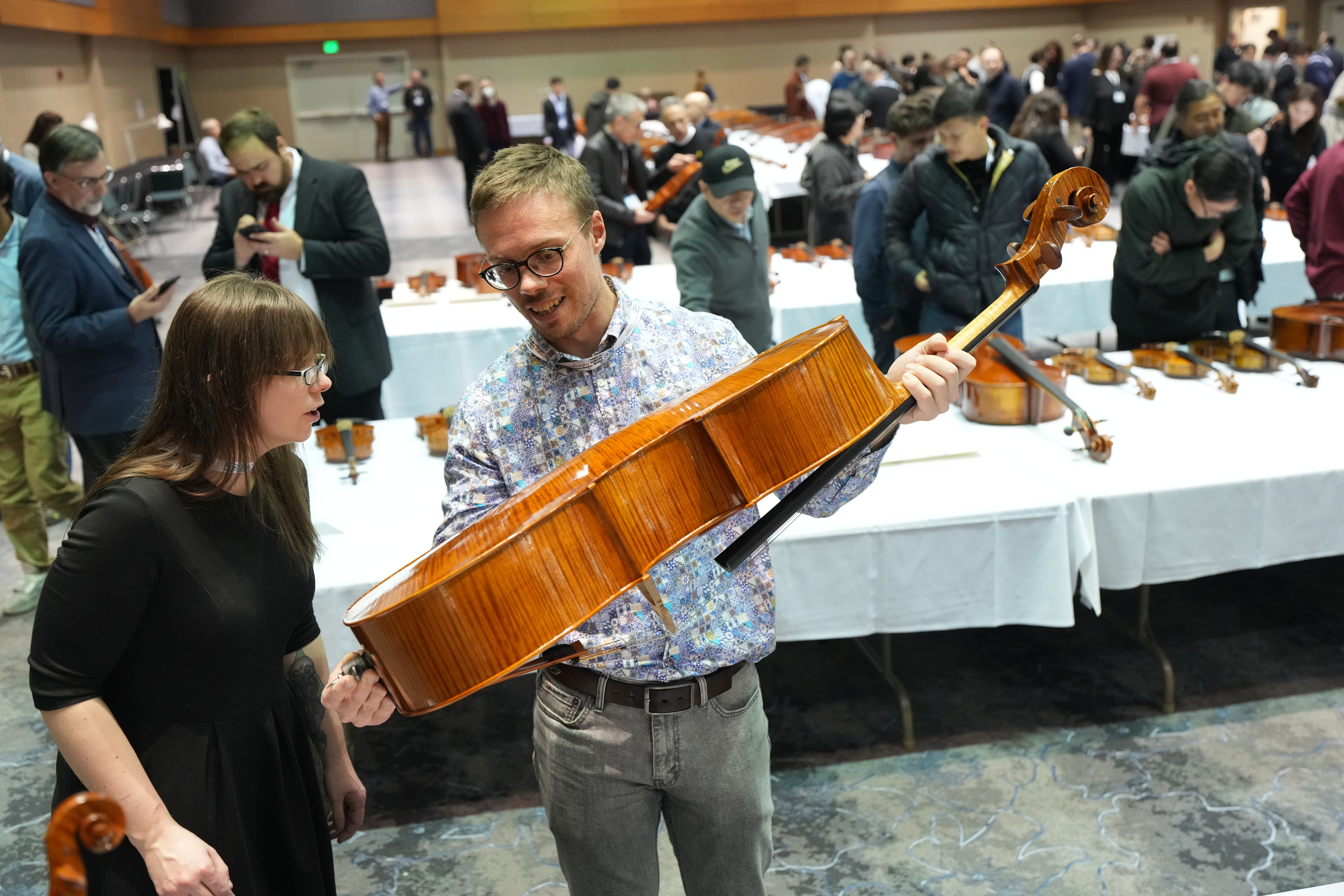
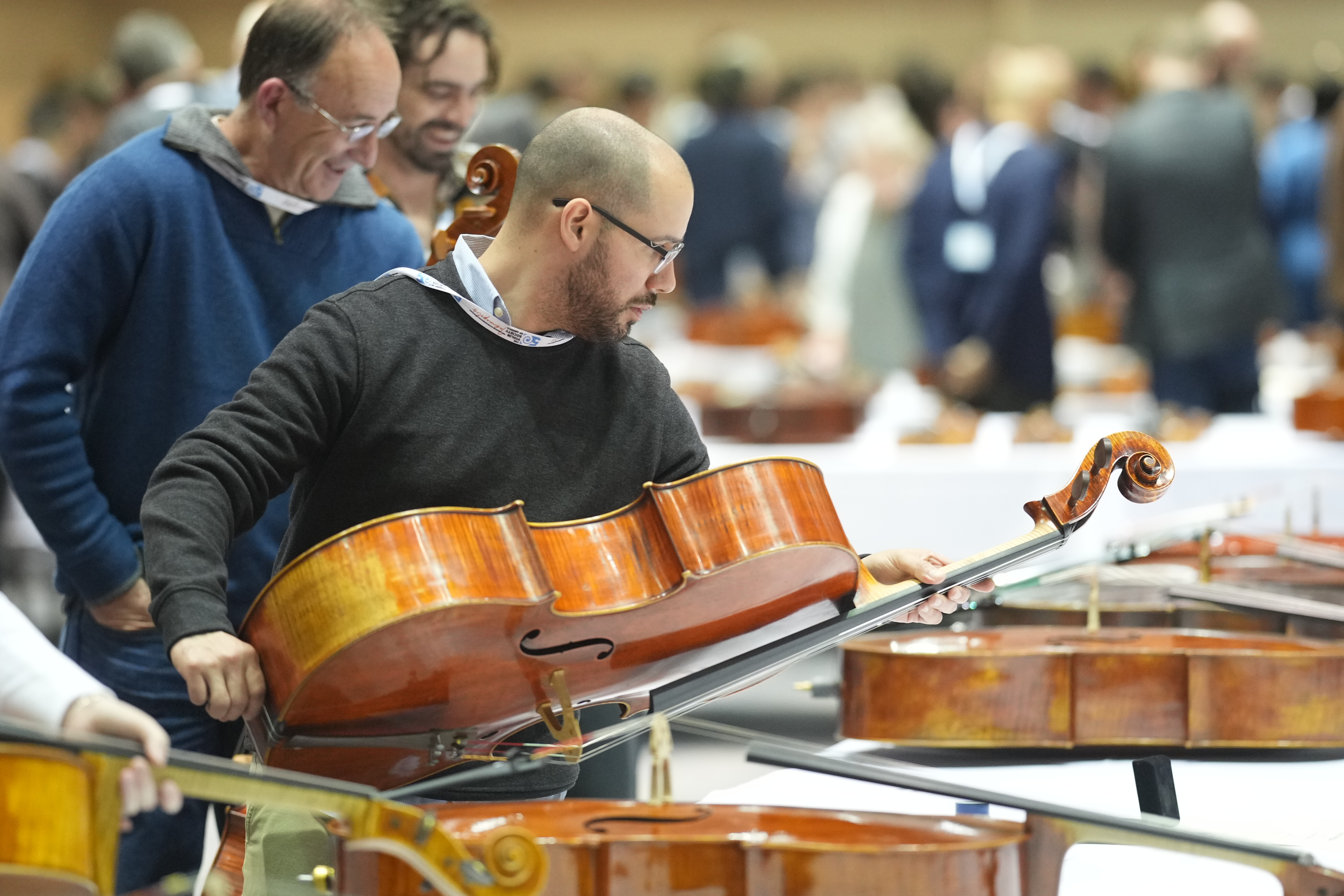
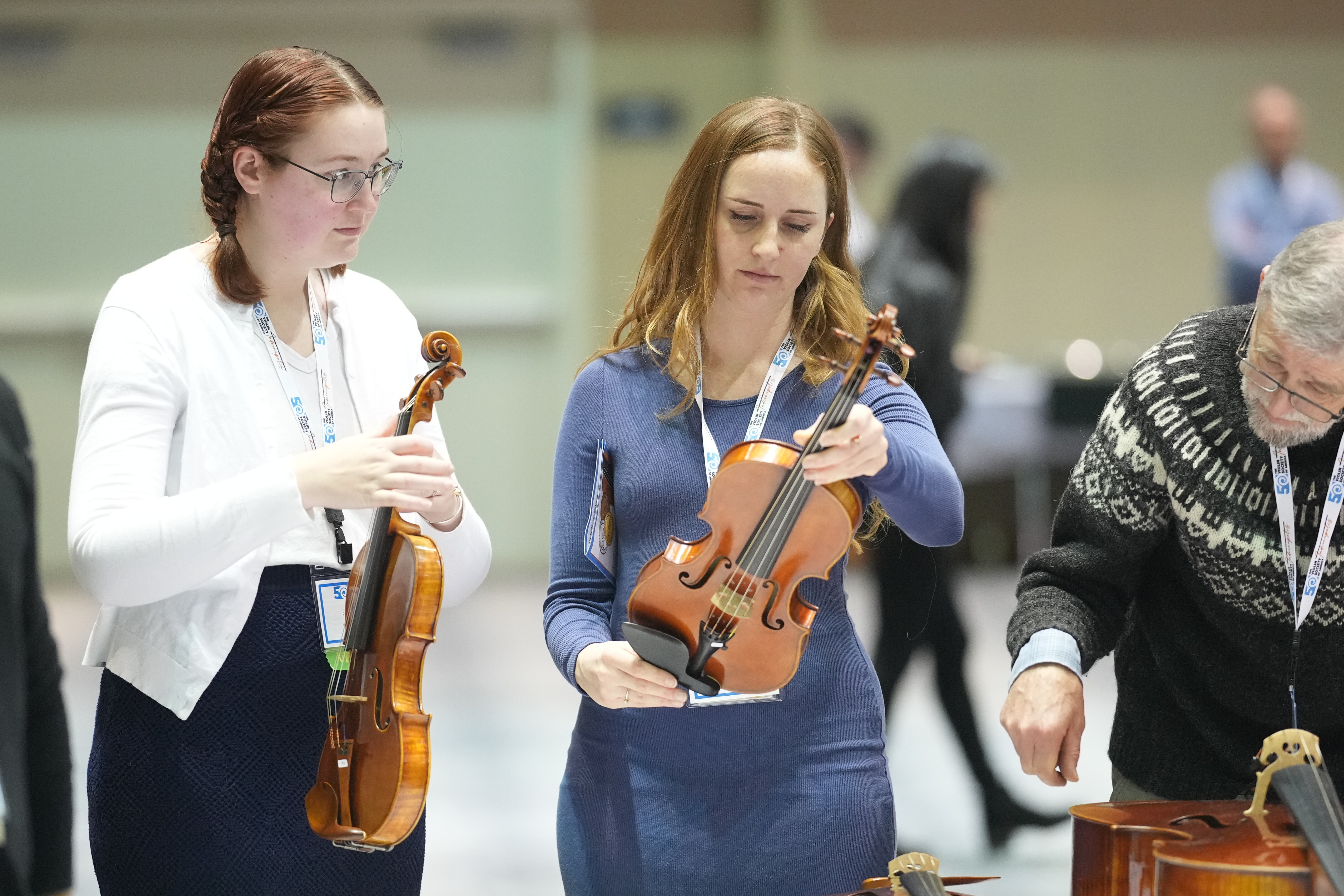
The 26th International Competition in Cleveland
November 15-20, 2026
Hotel Cleveland, Autograph Collection
24 Public Square
Cleveland, OH 44113
A Premier Event for Contemporary Instruments & Bows
Registration open through October 18
Held concurrently with the convention, the competition is The VSA's premier event to honor outstanding achievements by contemporary luthiers. Competitors from the around the world are invited to enter their instruments and bows for blind judging in categories of Tone and Artisanship by distinguished panels of makers and musicians.
Enter the Competition
Competition Details
See the complete information below, or download a PDF to print.
Competition Objective
The competition’s objective is to inspire the creation of outstanding, artistic, concertquality instruments and bows. Artisanship and tone judges are instructed to identify those instruments and bows having the greatest artistic merit, technical execution, and in the case of instruments, tone quality.
Deadlines
October 18 – Registration Deadline
October 1-31 – Window for receipt of shipped entries by host shop
November 15, 6:00-10:00 p.m. ET – Competition entry check-in
November 20, 1:00-4:30 p.m. ET – Competition entry early check-out (with fee)
November 20, 9:00-12:00 p.m. ET – Competition entry check-out
There will be no on-site registration of entries. You must present your confirmation in case of any registration questions. The entry deadline is October 18, 2026, 11:59 m. (ET)- OR - when the maximum number of instruments or bows in any categoryis reached. No registrations will be accepted after this date. Please register promptly.
Registration is only available through the online system. You will be prompted to print the registration form immediately after payment. Bring that form with you to the competition or copy it and ship it with your instrument(s) or bow(s). Instrument(s) and bow(s) hand-carried to the competition must be delivered to the check-in location at the Hotel Cleveland on Sunday, November 15, 2026, between 6:00 p.m. and 10:00 p.m. ET. Instruments and bows that are shipped (host shop only) must be received between October 1, 2026 and October 31, 2026.
Hotel Information
Hotel Cleveland, Autograph Collection
24 Public Square
Cleveland, OH 44113
To make room reservations at the convention rate, call 1(216) 696- 5600 or visit: https://tinyurl.com/VSA-Hotel-...
Membership
All competitors must be individual members of the Violin Society of America (VSA) in good standing. If you are not a member, you may join using the online entry form at:
https://vsaweb.org/member-bene...
Fees
In addition to the competition fees, there is an additional charge to attend the lectures, instrument exhibits and other activities that occur during the competition week. The competition entry fee does not include entry to any events. These fees are detailed in this packet.
Insurance
Insurance for competition instruments and bows is the responsibility of the competitor. If you would like information about insuring your instrument or bow while
it is at the competition, contact:
Heritage Insurance Services, Inc.: 1-800-289-8837
Letters of Invitation
A letter of invitation will be provided to international competitors who need one to accompany a visa application for entry into the United States of America (USA). Please indicate this need on the competition registration form and check the applicable deadlines in your own country.
Eligibility
All competitors must be members of the VSA in good standing. Membership information is available on the web at https://vsaweb.org/member-bene.... Questions about VSA membership can be sent by email to info@vsaweb.org or by phone to 1-518-313-0023.
Entries
Each instrument maker may enter at most one (1) violin, one (1) viola, one (1) cello, and one (1) bass in the competition. Competitors may also enter a string quartet for the quartet competition. Bow makers may enter at most one (1) violin bow, one (1) viola bow, one (1) cello bow, and one (1) bass bow in the competition.
If a competitor enters a string quartet, the quartet entry must include two (2) violins, one (1) viola, and one (1) cello. The competitor must clearly identify which violin is the first violin and which is the second violin. In addition, one (1) of the violins from the quartet, as designated by the competitor and not necessarily the first violin, along with the quartet’s viola and cello, must also be entered in the individual instrument competition. For a quartet entry, the fees for one (1) violin, one (1) viola, and one (1) cello will be paid.
To create a level playing field for tone judging, all basses must be set up with standard orchestral tuning. Solo strings are not permitted. Baroque instruments, baroque bows, and pre-modern bows may not be entered in the competition.
A maximum of two (2) makers, “co-makers,” may collaborate on any single entry. Co-makers may submit entries in multiple categories, provided that no co-maker enters more than one (1) instrument or bow of the same type, whether individually or as part of a co-maker entry.
Registration & Deadlines
Complete the online competition entry form and enter your payment information by October 18, 2026, at 11:59 p.m. ET. Registrations will not be accepted after this date, no hard-copy registrations will be accepted, and there will be no on-site registration of entries. Please register promptly since registrations may be rejected when the maximum number of instruments in any category is reached. You will be prompted to print a copy of your form after your registration is completed. Bring this confirmation with you to the competition or copy it and ship it with your instrument.
Instruments and bows shipped must be received at the host shop between October 1, 2026, and October 31, 2026 (see shipping rules for details). Instruments and bows hand-carried to the competition must be delivered to the check-in location at the Hotel Cleveland on Sunday, November 15, 2026 between 6:00 p.m. and 10:00 p.m. ET. Please indicate at registration if you will be hand delivering or shipping your instrument(s) or bow(s) to the competition.
Where to Enter
Competitors may only enter the competition on the VSA website, using a credit card.
The deadline is midnight ET, October 18, 2026.
https://vsa.memberclicks.net/c...
With respect to online entries, the VSA is not responsible for lost or delayed entries due to computer system, phone line, hardware, software or program malfunctions or other errors, failures, delayed computer transmissions, network connections, or entries sent to wrong addresses.
Competition Entry Fees
Instruments (each) $250
Quartets (2 violins, 1 viola, 1 cello) $750
Bows (each) $150
Other Fees
Convention Registration
EARLY BIRD: Student Member Registration $150
STANDARD: Student Member Registration $195
SINGLE-DAY: Student Member Registration $95
EARLY BIRD: Regular Member Registration $495
STANDARD: Regular Member Registration $595
SINGLE-DAY: Regular Member Registration $225
All shipping fees and all insurance coverage for instrument(s) and bow(s) to, from,
and during the competition, are completely the responsibility of the competitor.
Withdrawals & Refunds
All withdrawals from the competition must be in writing sent by email. Competition fees will be refunded less an $85.00 processing fee if a refund request is received by October 18, 2026. No refunds will be given for requests received after October 18, 2026.
Liability
The VSA will take all reasonable precautions to ensure the safety of instruments or bows entered in the competition. However, the VSA is not responsible for any loss, damage, or destruction of any instruments or bows during the competition and during the period in which instruments are stored at the host shop. The VSA is also not responsible for damage or losses of items during shipping to or from the competition or the host shop. Competitors are responsible for insuring their own instruments.
Check In/Out Form Required to Retrieve Instrument(s) or Bow(s)
A copy of the VSA Check In/Out Form with a red number will be issued to the maker of each instrument or bow that is hand-carried and delivered to the competition check-in desk. When the competition is over, the Check In/Out Form must be presented to VSA check-out personnel to obtain redelivery of the instrument(s) or bow(s). It is especially important that every maker who receives a Check In/Out Form keeps it safe until the Competition is over. If an instrument or bow is shipped to the host shop before the competition, the entry will be checked in according to the shipping instructions and VSA check-in records. Makers who ship their instrument(s) or bow(s) but wish to pick them up in person at the end of the competition must present their registration confirmation and photo identification to VSA check-out personnel. If another individual is designated to pick up the shipped instrument(s) or bow(s), that person must be identified in advance and must present photo identification at check-out. If the shipping instructions direct VSA to ship the instrument(s) or bow(s) back to the maker after the competition, a Check-In/Out Form will not be required for redelivery.
Early Removal of Entries
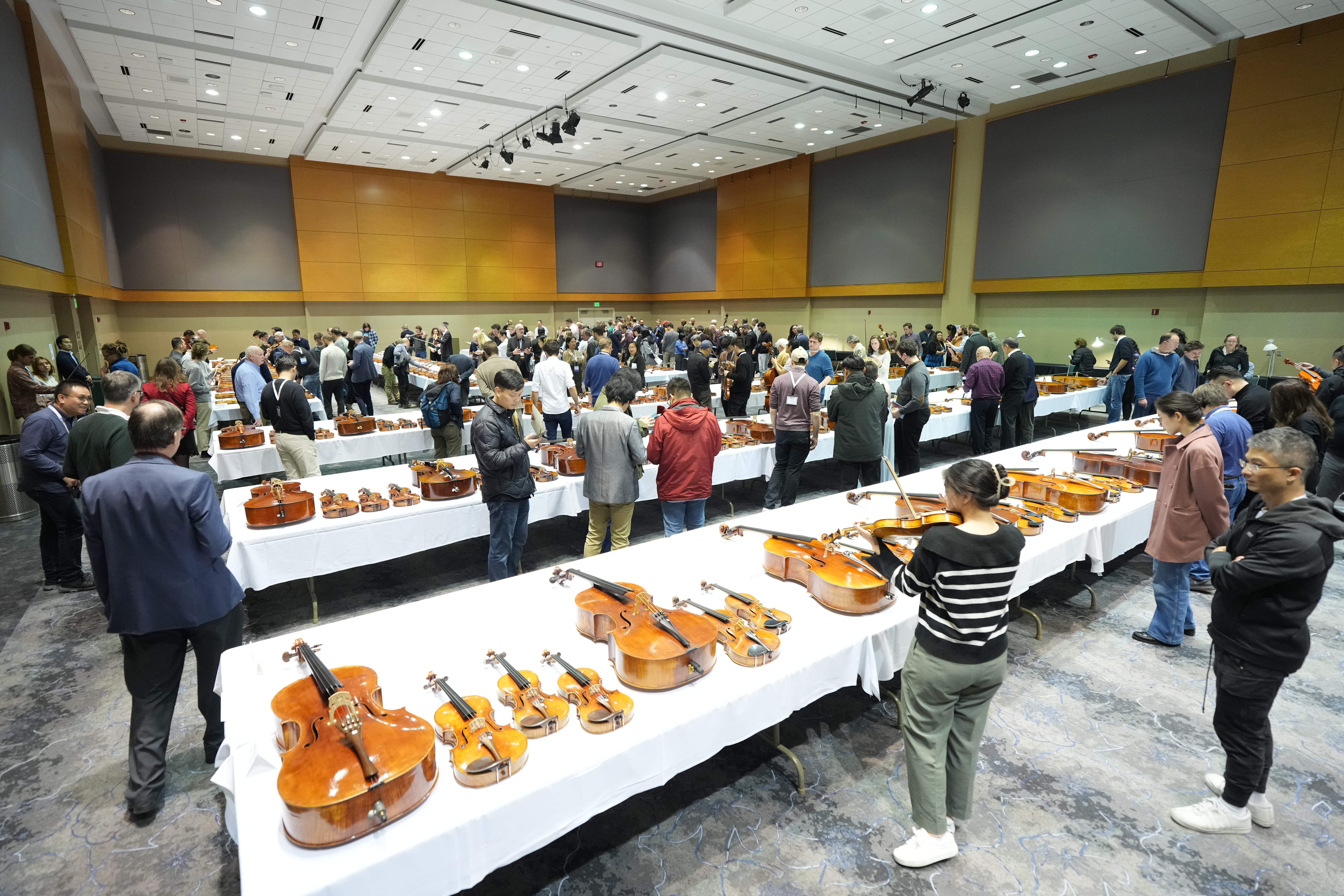
One purpose of the competition is to allow attendees to examine and play the instruments and bows that have been judged. To keep the competition exhibit complete and available to visitors through Friday, November 20, 2026, early checkout of instrument(s) or bow(s) will be limited to the designated early checkout period between 1:30 p.m. and 4:00 p.m. ET on Friday, November 20, 2026, and an $85 early checkout fee will be charged. If a competitor must leave early and chooses not to pay the early checkout fee, arrangements must be made to have the instrument(s) or bow(s) shipped to the competitor after the final day of the competition at the maker's expense. Instrument(s) and bow(s) may be picked up without penalty on Friday evening, November 20, 2026, between 9:00 p.m. and midnight ET.
Photographing Instruments & Bows
By entering this competition, competitors agree that any instrument(s) or bow(s) receiving a medal may be photographed by the VSA and that these photographs may be used by the VSA for publication or any other purpose, without prior permission of the maker. Photographs taken by the VSA of medal-winning instruments or bows will be made available to their makers for personal or professional use.
International Shipments Not Accepted
International instruments and bows may not be shipped to the VSA, the host shop, the hotel, or any other VSA-designated location. International competitors should review the International Competitors section below for guidelines on bringing their instrument(s) or bow(s) to the competition.
Domestic Shipping Rules & Guidelines
Shipping to the host shop is available only for instrument(s) and bow(s) shipped from within the United States. Domestic shipments must be sent to the host shop at the address listed below and must be received between October 1 and October 31, 2026. All shipments must be sent “Signature Required.” Competitors are required to forward all tracking information to the host shop at info@clevelandviolins.com.
Host Shop for domestic shipments only:
Cleveland Violins
Attn: VSA Competition
2917 Mayfield Rd
Cleveland, OH 44118-1047
info@clevelandviolins.com
Do not ship instrument(s) or bow(s) to the VSA office or hotel.
Shipping costs, including return shipping costs and insurance, are the sole responsibility of the maker. The VSA will not accept any instrument(s) or bow(s) into the competition for which incoming shipping costs or other fees are due. The VSA will not pay for the return shipment of any instrument(s) or bow(s). All arrangements for return shipping costs must be made in advance of the competition. The preferred method is to include a prepaid return shipping label inside the box containing the instrument(s) or bow(s), along with any special directions for repacking. Return shipping arrangements may also be made in writing directly with the host shop before the beginning of the competition.
To arrange for return shipping, competitors should either enclose a prepaid return shipping label with the shipment or email the return label to the host shop in advance. If the competitor would like the host shop to create the return shipping label, the competitor must provide a credit card to the host shop for all return shipping costs.
If no prior return shipping arrangements have been made, instrument(s) and bow(s) returned to destinations within the United States will be sent C.O.D. If return shipping costs remain unpaid, the VSA may keep the instrument(s) or bow(s) in its possession at the host shop until the return shipping cost plus an $85 storage/handling fee has been paid directly to the host shop. If these costs have not been paid after six (6) months, the VSA may take possession of the instrument(s) or bow(s) to be disposed of at its discretion.
Packaging & Handling
Please enclose a card with your instrument(s) or bow(s) with your name, email address, and phone number. We will contact you upon arrival of the instrument(s)
and/or bow(s).
It is the responsibility of the competitor to make sure that each shipped package contains a clearly worded packing slip stating exactly what the package contains, along with a copy of the competition registration confirmation. Because of similarities between some violin and viola bows, any viola bow should be tagged “viola.” Competitors are also responsible for ensuring that all labels, brands, or stamp marks that could identify the maker are covered or otherwise concealed at the time of entry to prevent judges from identifying the maker by looking at the instrument or bow.
Please do not ship in airtight plastic bags unless the instrument(s) and/or bow(s) are protected from contacting the plastic. The plastic may cause damage to the varnish.
During the competition, instrument(s) and bow(s) will be removed from their cases and displayed on linen-covered tables. Competitors are responsible for ensuring that all varnish is fully dry before the instrument is entered. Instruments with sticky or insufficiently cured varnish may be damaged by contact with the table covering, and the VSA assumes no responsibility for such damage.
Should an instrument arrive in need of adjustment or minor repair prior to the start of the competition, the VSA will have an expert luthier on call. In case of any major
damage during shipping, you will be notified immediately.
Due to the number of instrument(s) and bow(s) anticipated, please allow six (6) weeks for their return.
Questions concerning domestic shipping should be directed to the host shop.
Do not ship instrument(s) or bow(s) to the VSA office or hotel.
International Shipments to the Host Shop Not Accepted
International instruments and bows may not be shipped to the VSA, the host shop, the hotel, or any other VSA-designated location. Due to the increased liability and complexity of the import process, the VSA and the host shop will not accept international shipments or serve as the importer of record for international entries. International competitors must hand-carry their instrument(s) or bow(s) into the United States or make their own import arrangements with the appropriate customs authority, customs broker, carnet issuing agency, or other qualified advisor.
Letters of Invitation
Letters of invitation will be provided to international competitors upon request. These letters may be used to support a visa application for entry into the United States and to help explain that the competitor's instrument(s) or bow(s) are being brought into the United States temporarily for participation in the VSA Competition. The letter may also be used as supporting documentation when entering or leaving the United States with competition instrument(s) or bow(s); however, it does not replace any required customs, CITES, Lacey Act, carnet, import, export, or re-export documentation. Competitors who need a letter of invitation should indicate this on the competition registration form and are responsible for checking all applicable visa, customs, and documentation deadlines in their own country.
Required Customs & Materials Compliance
International competitors are responsible for ensuring full compliance with all applicable U.S. Customs, APHIS, CITES, U.S. Fish & Wildlife, Lacey Act, and home-country export requirements. Competitors should carry documentation sufficient to identify the instrument(s) or bow(s), confirm the purpose of travel, and support any required customs or materials declarations. Suggested documentation includes the competition registration confirmation, VSA letter of invitation, item description, photographs, value information, materials information, any applicable CITES permits or certificates, any required Lacey Act documentation, proof of legal/pre-2007 pernambuco where applicable, and any ATA Carnet or other customs documentation being used.
Carnets
Competitors from outside the United States are encouraged to obtain an ATA Carnet when temporarily bringing instrument(s) or bow(s) into the United States for the competition. An ATA Carnet, short for Admission Temporaire/Temporary Admission, is an international customs document that allows eligible goods to be temporarily imported and re-exported without paying customs duties or taxes, provided all requirements are met. Competitors should contact the customs authority or carnet issuing agency in their own country for specific requirements, deadlines, and filing procedures. More information is available through USCIB'S ATA Carnet resources at https://uscib.org/ata-carnet-export-service/faq/.
Lacey Act & Materials Declarations
The Lacey Act is a United States law regulating the import and export of certain plant and plant-based products and is administered by the USDA. When required, a Lacey Act declaration must identify the plant materials contained in the instrument or bow, including the required species and country-of-harvest information. These requirements may apply to importers, whether commercial or non-commercial, depending on the method of entry, classification, and applicable U.S. Customs requirements.
Paper copies of Lacey Act declarations are no longer accepted. Required Lacey Act declarations must be filed electronically through U.S. Customs and Border Protection's Automated Commercial Environment (ACE) or through APHIS' Lacey Act Web Governance System (LAWGS). Competitors should review the official USDA APHIS Lacey Act filing guidance at https://www.aphis.usda.gov/plant-imports/file-lacey-act-declaration and the Lacey Act Web Governance System at https://lawgs.aphis.usda.gov. Additional Lacey Act information for violin and bow makers is available through the International Alliance of Violin and Bow Makers for Endangered Species at https://www.alliance-international.org/lacey-act-resources/.
Prohibited Materials
Some plant and animal species are prohibited from import into and export from the United States, including but not limited to elephant ivory, tortoiseshell, and genuine whalebone. Violations of U.S. law may result in seizure and forfeiture of the instrument or bow. It is the competitor's responsibility, and not the VSA's, to obtain all necessary export or import licenses, permits, certificates, declarations, and other required documentation.
Pernambuco Bows
Any bow stick made from pernambuco must use pernambuco that was legally sourced and harvested prior to the 2007 CITES restrictions, also referred to as pre-2007 or pre-CITES pernambuco.
International bow makers entering bows in the VSA Competition will be provided with a letter of invitation confirming that the bow is being brought into the United States for competition purposes only. International pernambuco bows entered in the VSA Competition or brought into the United States in connection with the VSA Competition or Convention may not be sold, transferred, delivered to a buyer, or otherwise remain in the United States following the Competition. All such bows must be returned to the bow maker after the Competition. Any future sale or transfer may occur only after the bow maker has obtained all required CITES permits and any other applicable import, export, or re-export documentation.
General Rules
Rules and judging procedures for the international competition have been designed to ensure fairness to all competitors. Instrument(s) or bow(s) submitted for competition must have been completed after November 2024. Instrument(s) and bow(s) may not be entered if they have already received awards in other recognized international competitions. The decision of the judges is final.
Hors Concours status is granted to a maker who has been awarded Gold Medals in three different VSA competitions. Hors Concours status will not be granted for three Gold Medals awarded in one or two competitions. Makers designated Hors Concours status are not allowed to enter further VSA competitions. A maker who has been awarded Hors Concours status in the category of instrument making may still compete in the bow making competition. Likewise, a person holding Hors Concours status as a bow maker may enter the instrument competition.
Materials Requirements and Restrictions
All instruments and bows accepted into the competition must have essential parts that are handcrafted from traditional legal materials. Entries that do not comply with the following guidelines will be disqualified from the competition.
For stringed instruments, essential parts include the top, back, sides, and scroll. Synthetic or composite materials are allowed for the fingerboard, fittings, and instrument accessories, including the tailpiece, pegs, endpin, chin rest, and strings.
For bows, the bow stick is the essential component and must be handcrafted from traditional legal materials. Examples of traditional stick materials include solid woods such as pernambuco, snakewood, and ipe. Any bow stick made from pernambuco must use pernambuco that was legally sourced and harvested prior to the 2007 CITES restrictions, also referred to as pre-2007 or pre-CITES pernambuco.
The bow frog may be made from either traditional legal materials or synthetic/composite materials, provided it is crafted or shaped in a traditional manner. Synthetic or composite materials are also permitted for the head plate, head plate liner, eyes, slide over the mortise, heel plate, and winding.
NEW! All bows entered in the competition must be silver-mounted. Gold-mounted bows or bows mounted with any other non-silver metal are not permitted. This requirement is intended to create a level playing field for bow judging by ensuring that entries are evaluated on craftsmanship, playing qualities, and workmanship rather than the perceived value or visual impact of precious metal fittings.
Instruments or bows that incorporate tortoiseshell, elephant ivory, genuine whalebone (baleen), or any other banned materials will be automatically disqualified from the competition. These materials are also restricted under the Endangered Species Act and may be confiscated by U.S. Customs if transported across U.S. borders.
Questions about traditional material use may be directed to the VSA office.
Instrument Setup
Access to instruments and bows will not be permitted from the time they are checked in until all judging is completed. Proper setup of the instrument(s) submitted at the competition check-in desk is the responsibility of the maker or their representative. For shipped instruments, an official of the VSA may assist with the final setup according to instructions provided by the maker.
During the competition, instrument(s) and bow(s) will be displayed on linen-covered tables. Competitors are responsible for ensuring that all varnish is fully dry before the instrument is entered. Instruments with sticky or insufficiently cured varnish may be damaged by contact with the table covering, and the VSA assumes no responsibility for such damage.
The VSA will designate a qualified luthier to oversee small simple repairs should the need arise. This will include replacing broken strings, adjusting chin rest mounts, if necessary, and closing open seams between the ribs and plates. It is expected that some instruments may experience open seams during the competition. A luthier designated by the VSA will close any such open seams with diluted hide glue to enable the instrument to participate in the tone competition. The judges will be informed of the repair and shown its location on the instrument.
A competitor who would prefer that no one repair their instrument or bow should mark "No" in the appropriate place on the registration form. In this instance, any instrument which experiences seam openings or other problems will be removed from the competition and will be returned to the competitor at the conclusion of the competition. The competition fee will not be refunded. If a problem occurs during the Judging phase of the competition, the VSA cannot contact the competitor because this would necessitate a breach of security concerning anonymity.
Affidavit of Authenticity
All makers must sign an affidavit on the entry form indicating that the instrument(s) or bow(s) have been made entirely by themselves. Fittings such as pegs, tailpieces and endpins on an instrument may be commercially produced. Bass machine gears and C extensions that are commercially produced may be used by the maker listed. Bow frogs and buttons may not be commercially produced. Makers are not permitted to sub-contract work on instruments or bows submitted.
Anonymity Rules
All instruments and bows must have a LEGIBLE label, brand, or stamp mark. This is so that the maker may be positively identified, if necessary, at the conclusion of the competition after the judging has taken place. To ensure impartiality, the identity of the makers of the instrument(s) and bow(s) is withheld from the judges during the competition. To prevent the judges from identifying the maker by looking at the instrument's label, brand, or stamp mark, it is the responsibility of the contestant to make sure that all such labels, brands, or stamp marks are covered or otherwise concealed at the time of entry.
Additionally, to ensure anonymity, maintain the integrity of the competition, and prevent any potential biases resulting from public exposure, competitors are strictly prohibited from posting photos of their competition instruments or bows online or on social media prior to the competition. Any previously posted photos of competition instruments or bows must be taken down prior to registering for the competition. Compliance with this rule is mandatory, and any violation may result in disqualification.
Rules Committee
The responsibility for interpretation of on-site competition rules, the settling of disputes, and dealing with questions arising during the competition lies with the VSA Competition Rules Sub-Committee. All final decisions remain the responsibility of the VSA Executive Committee.
Rules Infractions
Potential rules infractions will be investigated by the Rules Sub-Committee with consultation from the appropriate judges. After the investigation, the Rules Sub-Committee will report their findings and recommendations to the VSA Executive Committee. The Executive Committee will then make the final decision on whether the rules have been broken and determine the appropriate response if a violation has occurred.
Instruments or bows that do not comply with competition rules will be disqualified, and all entry fees for disqualified items will be forfeited. Anyone caught attempting to commit fraud in the competition will be disqualified and may receive up to a lifetime ban from future VSA competitions.
Judges
The Competition Committee Chairs, in consultation with the Competition Committee, are responsible for selecting judges. The selection process emphasizes diversity, considering aspects such as nationality, tradition, and professional background. To ensure the highest level of integrity, all judges have agreed not to engage in buying, owning, or conducting any transactions involving instruments or bows that are part of this competition.
Bow Judging
Bow judging will be accomplished by three (3) judges and will be divided into two (2) rounds, Evaluation and Medal. In the Evaluation round, each judge will evaluate each bow independently and without consultation with the other judges. Bows that proceed to the Medal round will receive at least a Certificate of Merit. During the Medal round, the Certificate of Merit bows from the Evaluation round will be reviewed by all judges working together. Bows that receive a unanimous vote for superior Artisanship will be designated Gold Medal winners.
Bow Evaluation will be divided into six categories, totaling 100 points.
- Stick - 15 points
Includes planing, facets, diameter and taper, camber, mortise (for eyelet), and straightness.
- Head - 8 points
Includes elegance and precision of work, proportions, and mortise (tip).
- Frog and Button - 15 points
Includes proportions, finish, elegance, precision of work, fit of frog to stick and alignment with head, and fit of button.
- Playing Function - 14 points
Includes integration of camber, dimensions, height of head and frog, balance, and selection of wood.
- Finishing - 8 points
Includes finish, hair, and grip.
- Overall Impression - 40 points
Includes originality, choice of materials, elegance, overall consistency of style from frog to head and artistry.
Instrument Artisanship Judging
Artisanship judging will be conducted by three (3) judges for each instrument category: violin, viola, cello, and bass. Judges assigned to one category will have no input into decisions affecting other categories.
Judging will be divided into three rounds: Preliminary, Evaluation, and Medal. The Preliminary round is a screening round in which each instrument is reviewed independently by three (3) judges to determine which instruments will advance to the Evaluation round. The Evaluation round is the scoring round, where each judge independently evaluates and scores each instrument according to the applicable rubric. Based on those scores, judges will select the instruments that proceed to the Medal round.
Instruments selected for the Medal round will receive at least a Certificate of Merit for Artisanship. In the Medal round, judges review the selected instruments together. Instruments receiving a unanimous vote for superior Artisanship will be recommended for Gold Medals. Please read the rules below explaining the awarding of Gold Medals, Silver Medals, and Certificates of Merit.
Both antiqued and pristine instruments may be submitted. The judges are instructed to show no preference for either type.
Instrument Evaluation will be divided into six categories, totaling 100 points.
- Technical Execution - 20 points
Includes outline, glue joints, bending and fitting of ribs and purfling, execution of neck, edges, corners, f-holes, scroll, and finish work.
- Modeling - 12 points
Includes arching, surface texture, and f-holes, including positioning of f-holes, and shape relative to arching.
- Scroll - 8 points
Includes model, flowing lines, pegbox, finish work, and overall character.
- Varnish - 8 points
Includes color, transparency, ground, application, texture, and patina (if present).
- Setup - 12 points
Includes bridge, post, pegs, tailpiece, fingerboard, nut, saddle, and endpin.
- Overall Impression - 40 points
Includes originality, choice of materials, elegance, artistry, and consistency of style.
Instrument Tone Judging
Tone judging will be divided into three (3) rounds: Preliminary, Evaluation, and Medal. The Preliminary round is a screening round. Each instrument will be evaluated independently by three (3) playing judges, who will determine which instruments will receive further consideration in the Evaluation round. In the Evaluation round, the judges will further evaluate the instruments selected from the Preliminary round and determine which instruments will proceed to the Medal round.
Instruments selected for the Medal round will receive at least a Certificate of Merit for Tone. During the Medal round, the judges will review the selected instruments together. Instruments that receive a unanimous vote for the highest tone quality will be recommended for Gold Medals. Please read the rules explaining Gold Medals, Silver Medals, and Certificates of Merit under the heading "Awards."
Quartet Judging
Following the individual instrument competition, quartets will be judged for Artisanship and tone. Makers must have previously designated which violin is first and which is second. Makers may enter any combination of models within the quartet.
Quartet Artisanship Judging
The violin Artisanship judges will not participate in quartet Artisanship judging due to their greater workload. Quartets will be judged in two rounds, Evaluation and Medal. The viola and cello Artisanship judges will evaluate the quartet as a unit in one Evaluation round considering the following categories, totaling 100 points:
- Technical Execution - 40 points
Includes technical aspects of making, including the body, neck, scroll, setup, and consistency of construction among all four instruments.
- Varnish - 20 points
Includes color, transparency, ground, quality of application, texture, patina (if present), and consistency of varnish among all four instruments.
- Overall Impression - 40 points
Includes originality, choice of materials, elegance, artistry, and overall consistency of style, with consideration given to how successfully all four instruments work together as a cohesive set.
Quartets that proceed to the Medal round will receive at least a Certificate of Merit for Artisanship. Quartets that receive a unanimous vote as being of superior quality
in Artisanship will be recommended for Gold Medals. Please read the rules explaining Gold Medals, Silver Medals, and Certificates of Merit under the heading 'Awards.'
Quartet Tone Judging
Tone judging will be divided into two (2) rounds: Evaluation and Medal. During the Evaluation round, each quartet will be played and evaluated by four (4) playing tone judges and one (1) listening tone judge. Each judge will have an equal vote in determining which quartets will advance to the Medal round.
Quartets selected for the Medal round will be further reviewed by the four (4) playing tone judges and one (1) listening tone judge. The judges will work together to reach a consensus on Certificates of Merit and recommendations for Gold Medals. Please read the rules below explaining Gold Medals, Silver Medals, and Certificates of Merit.
There is no compulsory number of awards given, however, judges are given a general guideline of expected numbers before the competition starts.
Gold Medals (see Appendix 1)
For an instrument to receive a Gold Medal it must be recommended by all designated judges for such a Medal in one category and have at least a Certificate of Merit in the other category. A Double Gold Medal is awarded to instruments receiving a recommendation for a Gold Medal in both Tone and Artisanship categories.
A Gold medal is awarded to bows that receive a unanimous vote by the judges for superior Artisanship.
Silver Medals (see Appendix 1)
A Silver Medal in Artisanship or Tone is awarded if judges recommend a Gold Medal in one category and do not have a recommendation for Gold Medal or Certificate in the other category.
Bows are judged on Artisanship only. There are no Silver Medals awarded in the bow making competition.
Bronze Medals (see Appendix 1)
A Bronze Medal is awarded if judges recommend an instrument for a Certificate of Merit in both Tone and Artisanship categories.
Bows are judged on Artisanship only. There are no Bronze Medals awarded in the bow making competition.
Certificate of Merit (see Appendix 1)
An instrument will receive a Certificate of Merit in a category if it reaches the Medal round in that category and does not receive recommendation for Gold Medal in either category.
Bows that proceed to the Medal round but do not receive a Gold Medal will receive a Certificate of Merit.
Policy for Advertising of Medal and Certificate Recipients
A VSA award may be advertised as a credential of the award recipient, provided the advertisement clearly identifies the award recipient and accurately describes the award received. If a VSA award is referenced in connection with a specific instrument, bow, or quartet, the advertisement must not state or imply that the specific item received the award unless that item was the actual award-winning entry.
References to VSA awards must not be used in a misleading manner or in a way that suggests the award belongs to a dealer, seller, owner, business, subsequent holder, or non-awarded instrument, bow, or quartet. Any advertising, publicity, sale listing, promotional material, website, social media post, or other public reference to a VSA award must include the name of the award recipient.
Failure to comply with this policy may result in expulsion from VSA membership, forfeiture of VSA awards, or other remedies available to the VSA.
Instruments and bows that receive medal awards will be photographed by the VSA for publication. These photographs will be made available to the award recipients for their private or public use.

Important Notice
2026 Competition Bow Requirements
While competitors are responsible for the complete rules of the 26th International Competition above, here are two especially important updates for bow entries this year.
Pernambuco Bows
For the 2026 VSA Competition, any bow with a pernambuco stick must be made from legally sourced pernambuco harvested prior to the 2007 CITES restrictions, commonly referred to as pre-2007 or pre-CITES pernambuco.
The VSA is adopting this requirement as a clear and consistent competition standard in response to the increasingly complex international regulations surrounding pernambuco. It is intended to provide competitors with a straightforward eligibility rule while supporting responsible use and stewardship of this protected resource.
International competitors bringing pernambuco bows into the United States for the Competition may request a VSA letter confirming that the bow is being imported for competition purposes only. These bows may not be sold, transferred, or remain in the United States following the Competition and must be returned to the maker or owner.
Competitors are responsible for complying with all applicable CITES, customs, import, export, and other international trade requirements. The VSA will not independently verify the provenance or legal compliance of individual entries. Acceptance into the Competition does not constitute a determination by the VSA that a bow satisfies applicable laws or regulations.
Silver-Mounted Bows Only
As a reminder, only silver-mounted bows will be accepted in the 2026 VSA International Competition. Gold-mounted bows and bows with other precious-metal mountings are not eligible.
Competition Eligibility
Competitors must be members of the VSA in good standing. Follow the link to learn more about membership.
Competition Inquiries
Email our general inbox info@vsaweb.org with your questions and the competition organizing committee will respond within a few business days.
Convention Information
Looking for more information on the convention activities and programming the week of the competition?
Judges
Violin
Artisanship
Carlo Chiesa
John Montgomery
Chris Reuning
Tone
Sirena Huang
Cho-Liang Lin
Daniel Phillips
Viola
Artisanship
Frédéric Chaudière
Christopher Germain
Marilyn Wallin
Tone
Catharine Caroll Lees
Daniel Orsen
Peter Slowik
Cello
Artisanship
Robin Aichinson
Raymond Schryer
Stephan Von Baehr
Tone
Ilya Finkelshteyn
Anne Martindale Williams
Camden Shaw
Bass
Artisanship
Jim Ham
Zachary Martin
Arnold Schnitzer
Tone
Charles Carleton
Timothy Pitts
Derek Zadinsky
Bow
Artisanship
Thomas Gerbeth
Pierre Guillaume
Lee Guthrie
Quartet
Tone
The Verona Quartet
Further Details TBA
More information is forthcoming on the Awards Ceremony the evening of Thursday, Nov 19, and the Public Viewing on Friday, Nov 20.